The Cost of an Unprovable Corporate Claim
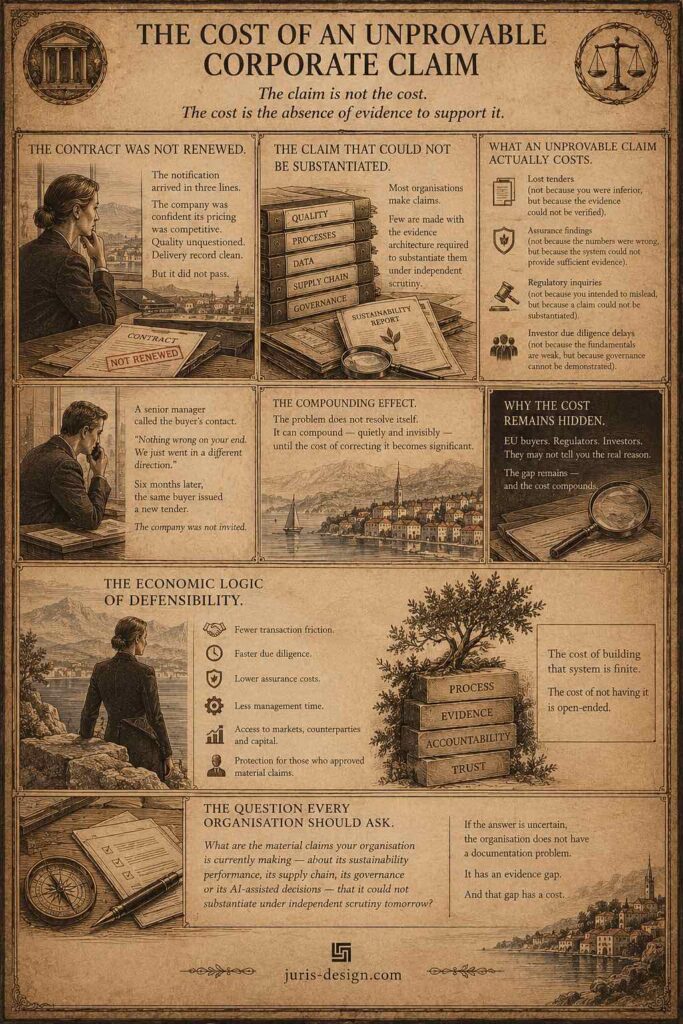
The contract was not renewed. The notification arrived in three lines. The company was confident its pricing was competitive. Quality unquestioned. Delivery record clean. But it did not pass. A senior manager called the buyer’s contact. “Nothing wrong on your end. We just went in a different direction.” Six months later, the same buyer issued a new tender. The company was not invited.
The Claim That Could Not Be Substantiated
Every organisation makes claims. About the quality of its processes. About the reliability of its data. About the sustainability of its supply chain. About the governance structures behind its decisions. Most of those claims are made in good faith. Few are made with the evidence architecture required to substantiate them under independent scrutiny.
And in a business environment where sustainability disclosures, supply chain representations, AI-assisted decisions and board statements are increasingly subject to verification, the gap between a claim and a provable claim is no longer merely a compliance question. It is an economic one.
What an Unprovable Claim Actually Costs
The cost of an unprovable corporate claim is rarely visible at the moment it is made. It becomes visible later. Sometimes much later. And by then, the cost has compounded. Consider what happens when a material claim cannot be substantiated under scrutiny.
A tender is lost - not necessarily because the offering was inferior, but because the due diligence process revealed that the underlying data could not be verified. The buyer chose a supplier whose documentation required less remediation.
An assurance engagement identifies a material evidence or control deficiency - not necessarily because the reported figures were wrong, but because the system that produced them could not provide sufficient appropriate evidence to support them. The cost of remediation may exceed the cost of building the system in the first place.
A regulatory inquiry opens - not because the organisation intended to mislead, but because a public sustainability claim could not be substantiated at the time it was made. Legal costs, management time and reputational exposure follow.
An investor due diligence process stalls - not because the business fundamentals are weak, but because governance documentation is incomplete and accountability structures cannot be demonstrated. The transaction timeline extends. Terms may be renegotiated. Value can be lost.
In each case, the cost is not the claim itself. The cost is the absence of evidence to support it.
The Compounding Effect
What makes unprovable claims particularly expensive is not their immediate cost. It is the compounding effect of the problem remaining unaddressed. An organisation that loses a tender for reasons it does not understand may enter the next tender with the same gap. An organisation that receives an assurance finding without addressing the underlying system weakness may face similar evidence problems again.
And one unprovable material claim should raise a broader question:
What else in the organisation depends on evidence that has never been structured to withstand scrutiny? The problem does not resolve itself. It can compound - quietly and invisibly - until the cost of correcting it becomes significant.
Why the Cost Remains Hidden
EU buyers rarely say: “You did not pass because your evidence architecture was insufficient.”
They may simply say: “We went in a different direction.”
Regulatory scrutiny may begin with a request for documentation rather than an explicit statement that a claim was unprovable.
Investors may not decline a transaction by saying: “Your governance cannot be demonstrated.” They may instead extend timelines, request additional evidence or seek changes to the transaction terms. In each case, the underlying issue may remain unspoken. And the organisation that does not understand the real reason continues operating with the same gap - and may pay the same cost repeatedly without knowing why.
The Economic Logic of Defensibility
There is an economic logic to defensibility that organisations are beginning to recognise. A system capable of substantiating material corporate claims does not only reduce legal exposure. It can reduce transaction friction. It can accelerate due diligence processes. It can reduce the cost of responding to assurance requests. It can protect management time. It can reduce friction in access to markets, counterparties and capital.
And it can protect the individuals who made and approved material claims - because those claims were made within a system capable of demonstrating how they were produced, what evidence supported them and why reliance on them was reasonable. The cost of building that system is finite. The cost of not having it is open-ended.
The Question Every Organisation Should Ask
What are the material claims your organisation is currently making - about its sustainability performance, its supply chain, its governance or its AI-assisted decisions - that it could not substantiate under independent scrutiny tomorrow?
If the answer is uncertain, the organisation does not have a documentation problem. It has an evidence gap. And that gap has a cost. The only question is whether the organisation discovers that cost on its own terms - or on someone else’s.
Other blogs


Cost of an unprovable corporate claim
The contract was not renewed. The notification came in three lines. The company was convinced that...
You can lose a tender before anyone even cites ESG as the reason.
The formal notification came in three lines. The company was sure that the price was…