Author: Mehmed

  • U.S. Supreme Court vs. the Executive Branch: what Balkan exporters need to know

    U.S. Supreme Court vs. the Executive Branch: what Balkan exporters need to know

    Analysis of the decision Learning Resources, Inc. v. Trump and its operational consequences

    What happened?

    On February 20, 2026, the Supreme Court of the United States issued its decision in the case Learning Resources, Inc. v. Trump, invalidating the tariff regime that the presidential administration had introduced under the International Emergency Economic Powers Act (IEEPA). In a 6–3 ruling, the Court held that tariffs are not a regulatory instrument—they are a form of taxation. The power of taxation under the U.S. Constitution belongs to Congress, not the executive branch, and cannot be derived from a general statutory authorization to manage emergencies.

    This is not a narrow trade decision. It is a constitutional ruling on the limits of executive power in the economic sphere.

    The Court applied the Major Questions Doctrine: where executive action carries economic and political significance of vast scale—here, a tariff regime generating between $160 and $175 billion in revenue—clear and explicit congressional authorization is required. General language in emergency legislation does not meet that threshold.

    What followed?

    On March 4, 2026, the U.S. Court of International Trade (CIT) ordered U.S. Customs and Border Protection (CBP) to initiate the process of refunding unlawfully collected duties. CBP is developing an electronic refund system called CAPE within its Automated Commercial Environment (ACE), with an interim deadline of April 20, 2026.

    The administration did not withdraw. It immediately introduced new tariffs—this time under Section 122 of the Trade Expansion Act of 1962, which constitutes clear congressional authorization. The tariff pressure therefore remains, only under a different legal basis.

    The government has until May 4, 2026 to file an appeal against the CIT order. If the appeal succeeds, the right to refunds could be limited only to the parties that initiated legal proceedings.

    Who is entitled to a refund—and why the answer is not simple?

    This is the point where Balkan exporters most often make incorrect assumptions.

    The right to file a claim in the CAPE system belongs exclusively to the importer of record in the United States—the U.S. legal entity that physically imported the goods into the country and paid the duty to CBP. That is your American buyer, distributor, or partner, not your company.

    A Balkan exporter has no direct right to a refund, except in one scenario: if, by contract, it assumed the role of the party bearing the customs burden.

    Here, the contractual structure is decisive.

    Incoterms are standardized rules of the International Chamber of Commerce that determine who bears costs and risks in international sales. Two clauses are operationally relevant:

    • DDP (Delivered Duty Paid) – the seller, i.e. your company, bears all costs including duties in the destination country. If you delivered under DDP in the period April 2025 – February 2026, you effectively bore the customs burden, either through pricing or directly.
    • DAP (Delivered at Place) – the goods arrive at the agreed location, but the duty in the U.S. is paid by the buyer. The customs burden is on the American partner.

    If your American partner operated under DAP, they bore the duty and now potentially have the right to a refund. This does not mean you were harmed in a legal sense. But it does mean that in negotiating new contractual terms, you possess a relevant fact about your partner’s economic position.

    Three operational steps

    Step 1: Review of contractual structure

    Review all contracts concluded or active in the period April 2025 – February 2026. Determine which Incoterms were used and who was contractually responsible for customs costs. This is not an administrative step—it is the legal basis for everything that follows.

    Step 2: Review of deadlines

    For entries that have not yet been liquidated: it is possible to file a post-summary correction directly with CBP. For entries that have been liquidated and where liquidation is not final: it is possible to file a protest under 19 U.S.C. § 1514. These deadlines run regardless of whether your American partner is taking action. If you miss the deadline, the right expires.

    Step 3: Contractual mechanism for the future

    The Learning Resources decision does not guarantee stability of the tariff environment. The administration immediately applied an alternative legal basis for new tariffs. New contracts must include clauses that clearly allocate customs risk and provide a mechanism for adjustment in case of regulatory change—regardless of which party bears the burden in a specific transaction.

    The broader picture

    The Learning Resources decision has implications that go beyond trade law. The U.S. Supreme Court has set a standard: the executive branch cannot assume core legislative powers by invoking general emergency authorities, even in the field of foreign economic policy. That principle—that economic measures of vast scope require clear legislative authorization—also resonates in the European regulatory space, particularly in the context of delegated acts and the implementation of the AI Act.

    For lawyers advising clients with export exposure to the U.S., this is the moment to review not only contractual clauses, but also the overall allocation of regulatory risk in existing and future arrangements.

    Other blogs

    Vrhovni sud SAD protiv izvršne vlasti: šta balkanski izvoznici moraju znati

    U.S. Supreme Court vs. the Executive Branch: what Balkan exporters need to know

    Analysis of the decision Learning Resources, Inc. v. Trump and its operational consequences...

    CSRD 2026: Pomak Omnibus I i standard dužne pažnje

    CSRD 2026: The Omnibus I Shift and the Standard of Due Diligence

    Beyond compliance: Why evidence architecture is now a legal necessity – and a personal risk…

  • CSRD 2026: The Omnibus I Shift and the Standard of Due Diligence

    CSRD 2026: The Omnibus I Shift and the Standard of Due Diligence

    Beyond compliance: why Evidence Architecture is now a legal necessity - and a personal risk for every director who signs.

    Most boards think Omnibus I bought them time. It didn’t. It transferred the risk - from the regulator to the director personally. Here is what a rigorous legal analysis of the March 2026 threshold changes actually reveals.

    1. The Extraterritorial Reality of the Supply Chain

    On March 19, 2026, the EU’s Omnibus I package raised CSRD reporting thresholds to companies with over 1,000 employees and turnover exceeding €450 million. The legislator narrowed the mandatory scope. The market did not follow.

    The legal obligation to report may be bounded by thresholds. The contractual obligation to provide data is not.

    If your German, Austrian, or Italian partner is CSRD-obligated -and they are - every gram of their sustainability burden travels downstream via contract. Whether you operate from Warsaw, Podgorica, Beograd, Zagreb, USA, Seoul, or São Paulo, the question has shifted permanently:

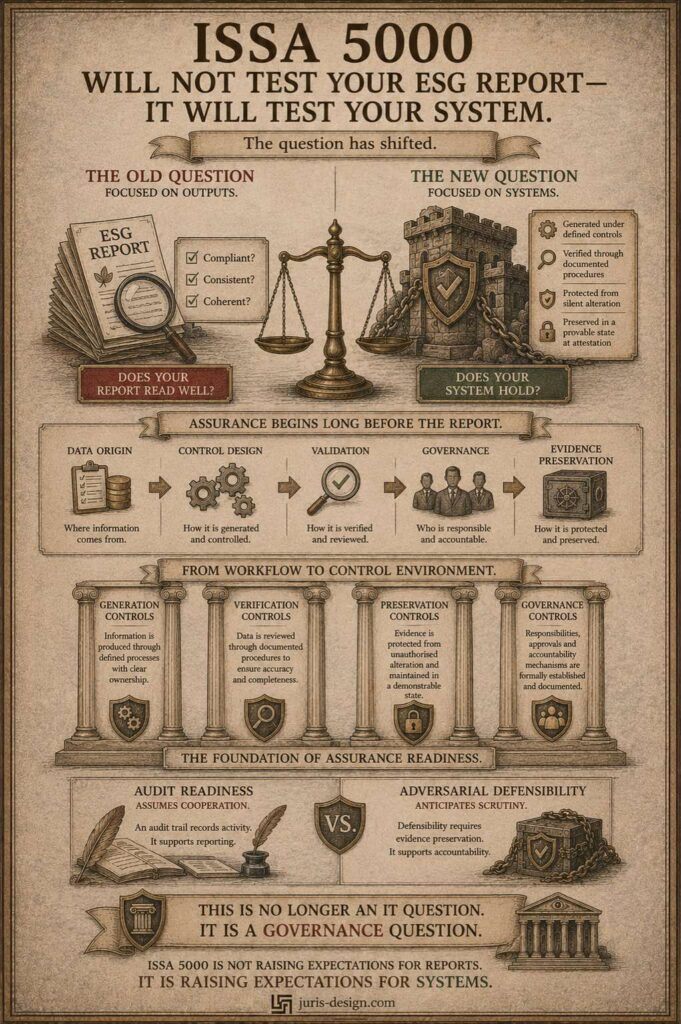
    The core legal question is no longer about the mandate to report. It is about the standard of proof.

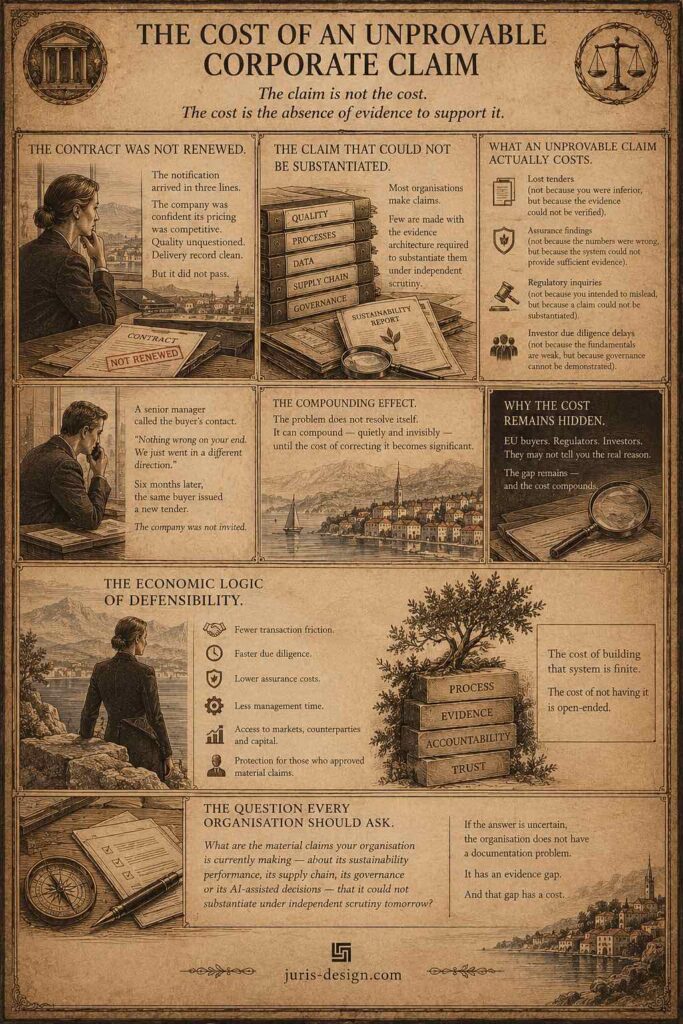
    Boards that interpreted the threshold increase as a reprieve misread the signal entirely. The compliance perimeter contracted. The evidentiary expectation did not.

    2. Evidence Architecture: The Forensic Standard

    Sustainability data is completing a transition that began years ago: from corporate communication to legal evidence.

    Across jurisdictions, a consistent pattern emerges in legal and audit practice: auditors do not challenge the data. They challenge the system that produced it.

    This is what I define as Evidence Architecture - the systematic design of audit trails that can withstand not just regulatory review, but legal scrutiny. An Excel spreadsheet or a PDF without a verifiable chain of custody does not meet this standard. It is not a compliance gap. It is a liability.

    What the Forensic Standard Requires:

    • Digital Chain of Custody - A traceable, time-stamped record from the point of data origin to final disclosure. Not a summary. A trail.
    • Methodological Consistency - Q1 data collection must be defensibly identical to Q4. Inconsistency is the first crack every auditor exploits.
    • Independent Verifiability - Data that can withstand third-party assurance and, where necessary, legal scrutiny. If it cannot be verified externally, it cannot be defended internally.

    3. Governance and the Personalization of Liability
    This is the conversation most boards are not having - and should be.

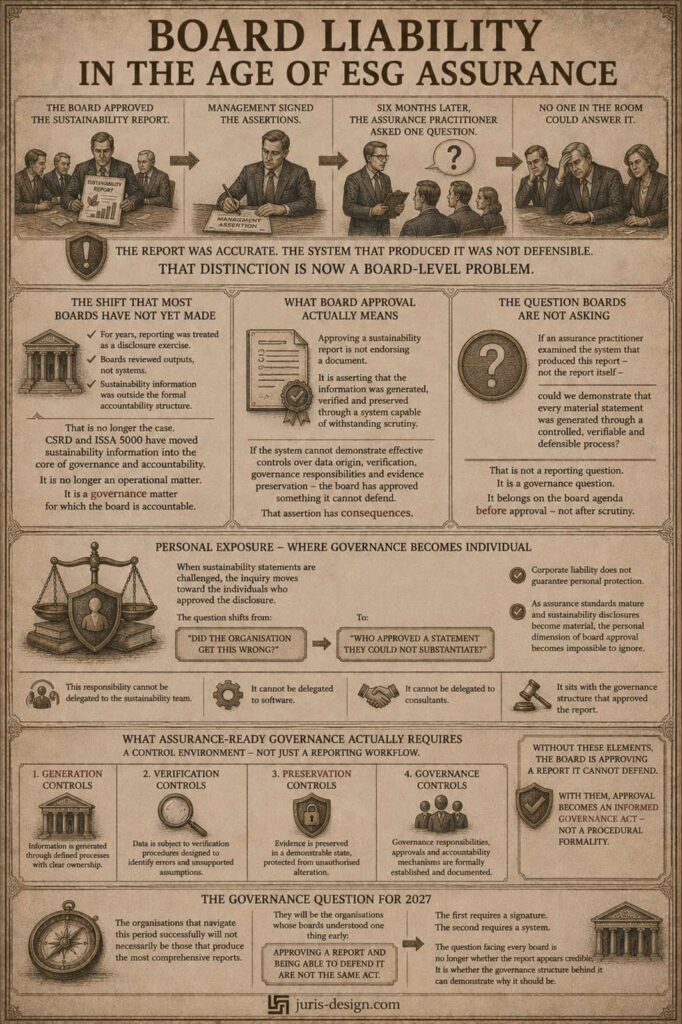
    Under the CSRD framework, sustainability reporting is elevated to board-level accountability. This is not rhetorical. It is structural. Directors who sign off on ESG disclosures that lack a robust evidentiary basis may be exposing themselves to regulatory sanctions, civil liability, and reputational consequences that follow individuals - not just organizations.

    When a sustainability claim fails audit, the question shifts from what went wrong to who authorized it. In the CSRD context, that person has a name on a board resolution.

    The legal framework is clear: if ESG cannot be substantiated through a designed system of proof, it represents a point of significant professional and legal exposure for those who signed it.

    4. The Value-Chain Cap: A Protection Most Suppliers Don’t Know Exists
    One of the most significant - and most overlooked - provisions of the Omnibus I package is the Value-Chain Cap.

    This provision establishes that large EU entities cannot demand sustainability data from smaller suppliers that exceeds the voluntary SME standards arriving in July 2026. It is a genuine statutory protection. And the majority of non-EU suppliers operating in EU supply chains are entirely unaware of it.

    They are overdelivering on data they are not legally obligated to provide, while underdelivering on the specific, verified data their partners actually require - creating simultaneous risks of unnecessary operational disclosure and continued liability exposure from unverified claims.

    Legal Design allows us to map these boundaries clearly: to identify precisely what you must not provide, and to deliver what you do provide with forensic precision. This is not a documentation exercise. It is a rights exercise.

    5. Legal Design as Operational Infrastructure
    The role of the modern lawyer is not to produce more complexity. It is to make compliance possible, visible, and defensible.

    Legal Design Thinking translates regulatory obligation into operational systems - visual, process-driven architectures where every data point in a sustainability disclosure has a clear, validated, auditable origin. Not hundred-page manuals that no one reads. Systems that employees can actually use and that auditors cannot dismantle.

    In the CSRD era, the primary objective is not merely to report. It is to ensure that every disclosure is rooted in a designed system of truth.

    Integrity Over Narrative. Regulations are subject to political and economic cycles. The structural shift toward verifiable accountability is not. The window created by Omnibus I threshold adjustments should be read precisely as that - a window, not an exit.

    The organizations that will lead in this era are not those with the most elaborate sustainability narratives. They are the ones who can answer one question, instantly, from any point in their supply chain:

    “Where did this number come from - and who validated it?”

    The window is open. The question is whether you are building a system - or just a story.

    Integrity in reporting is not found in the narrative. It is found in the evidence that supports it.

    LDT ESG CHECKLIST 2026 CSRD 2026 BLUEPRINT: ESG Proof Architecture

    Other blogs

    Vrhovni sud SAD protiv izvršne vlasti: šta balkanski izvoznici moraju znati

    U.S. Supreme Court vs. the Executive Branch: what Balkan exporters need to know

    Analysis of the decision Learning Resources, Inc. v. Trump and its operational consequences...

    CSRD 2026: Pomak Omnibus I i standard dužne pažnje

    CSRD 2026: The Omnibus I Shift and the Standard of Due Diligence

    Beyond compliance: Why evidence architecture is now a legal necessity – and a personal risk…

  • CSRD 2026 i Balkan

    CSRD 2026 and the Balkans: Postponement Is Not Relief

    Why proof has become the new currency - and how Balkan companies can win in a game whose rules have just changed.

    While Balkan directors and compliance officers were waking up with their morning coffee at the beginning of March, a decision was made in Brussels that made many breathe a sigh of relief - and the wiser ones think deeply. This change comes through the so-called Omnibus I package, through which the European Union simplifies rules related to sustainability reporting. The directive entered into force on March 19, 2026 and drastically raised the thresholds for CSRD reporting. If you think this is the “end of the headache” - you are mistaken.

    1. The big threshold cleaning: Who's out, who's in?

    The new thresholds are high: companies with more than 1,000 employees and turnover exceeding 450 million euros. For a region like the Balkans, this means that only the “heavyweights” will report directly - power utilities, telecoms and the largest industrial systems. However, this is where what I would call a legal boomerang appears.

    EU partner (Germany, AT, IT) ➡️ Distributor / intermediary ➡️ Your company

    The pressure of responsibility flows down the entire supply chain - even when you are not required to report.

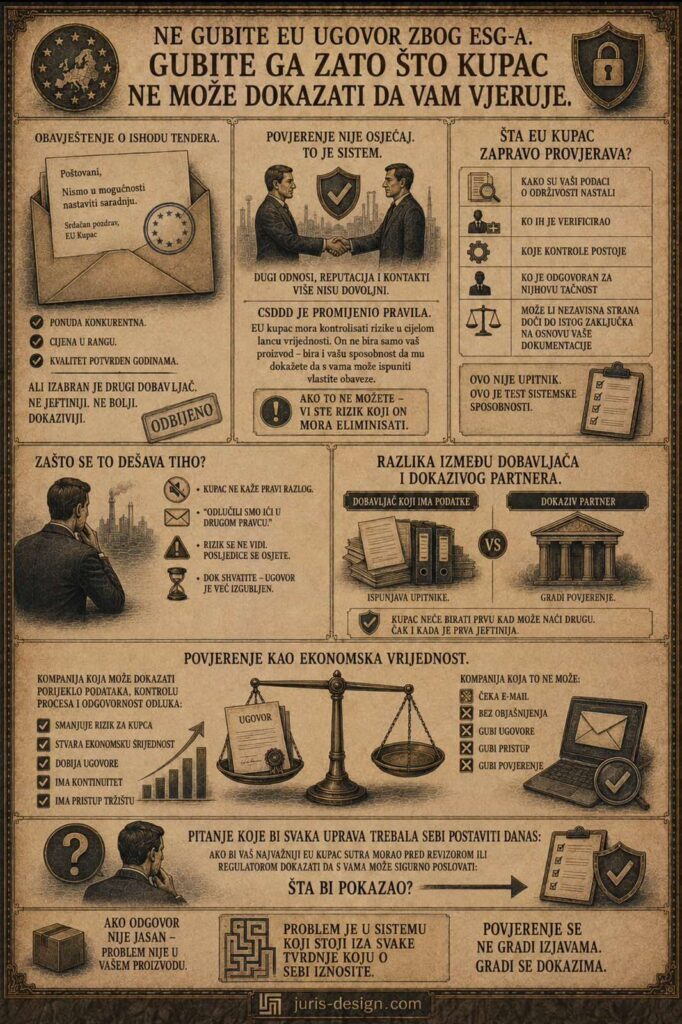
    Even if you are not required to write a 200-page report for Brussels, your partners in Germany, Austria or Italy are. And they will transfer every gram of their responsibility onto you.

    “You did not ask whether I am allowed to request this data from you. I asked him: can you afford not to provide it?”

    2. The Balkan paradox: Less law, more forensics

    As a lawyer working at the intersection of law and system design, I rarely see the problem in the law - I almost always see it in the fact that the law has not been translated into a process.

    Past practice in the region has often come down to “creative writing” of ESG strategies. That is dead letter on paper. With the new amendments, the EU focus shifts from the quantity of reports to the integrity of data. I see this as a transition to evidence forensics. Your European partner no longer asks for your statement that you do not pollute the river.

    WHAT YOUR EU PARTNER IS ACTUALLY ASKING FOR

    • Audit Trail - A digital trace from the sensor in the factory to the director’s signature. Every step documented, time-stamped, immutable.
    • Verifiability - Is that data “resistant” to a court proceeding? If tomorrow you are accused of greenwashing, where is your proof?
    • Consistency - Data from Q1 must be methodologically aligned with data from Q4. Inconsistency is the first gap through which an auditor enters.

    3. Shield for SMEs: The Value-Chain Cap

    One of the few real victories for Balkan small and medium-sized enterprises in Omnibus I is the introduction of a limitation of requests within the supply chain. Large players from the EU are no longer allowed to “harass” small suppliers with requests that exceed voluntary standards for SMEs - which arrive in July 2026.

    This is the key point where Legal Design comes into play. Instead of sending hundreds of unorganized documents, you design a map of proof.

    LEGAL DESIGN IN PRACTICE

    • You show what you do not have to provide - you know your rights and the limits of requests
    • You deliver what you deliver with absolute precision - every data point supported by proof
    • Your legitimacy before investors - you do not say “we are responsible”, you prove it

    4. How to win against the “late burnout effect”?

    In the Balkans we usually wait until the last moment. We negotiate with the deadline, not with the substance. But the architecture of facts is not built overnight - and greenwashing lawsuits do not wait for organization.

    “Digitize the evidence immediately. Not tomorrow, not after the election cycle, not when inspections pass. Immediately.”

    Start digitizing evidence today. Every sensor, every supplier contract, every certificate - into a system that leaves a trace.

    Turn legal obligations into visual processes. Let your compliance system be user-friendly for employees, and impenetrable for auditors. The complexity of the law does not have to be the complexity of your system. Facts are the only constant.

    Facts are the only constant

    Regulation will continue to change. Thresholds will rise and fall. Governments will promise and postpone. But the need for irrefutable proof is here to stay - because it is not only regulatory, it is market-driven.

    For Balkan companies, this is not only a question of ecology. This is a question of legal security and survival in the market.

    In a world where everyone promises sustainability, the one who can prove it will win.

    You thought CSRD was postponed? Think again. For the Balkans, the real game is just beginning. I explain why proof - not promise - is the new currency.

    Check your exposure level with the CSRD / ESG CHECKLIST – BALKAN EDITION Download the CSRD 2026 BLUEPRINT: ESG Proof Architecture

    Other blogs

    Vrhovni sud SAD protiv izvršne vlasti: šta balkanski izvoznici moraju znati

    U.S. Supreme Court vs. the Executive Branch: what Balkan exporters need to know

    Analysis of the decision Learning Resources, Inc. v. Trump and its operational consequences...

    CSRD 2026: Pomak Omnibus I i standard dužne pažnje

    CSRD 2026: The Omnibus I Shift and the Standard of Due Diligence

    Beyond compliance: Why evidence architecture is now a legal necessity – and a personal risk…

  • CSRD: When ESG Becomes a Personal Risk. How Proof Architecture Shifts ESG from Sustainability to Accountability

    CSRD: When ESG Becomes a Personal Risk. How Proof Architecture Shifts ESG from Sustainability to Accountability

    March has traditionally been about closing financial books. But starting in 2026, March carries a different weight for European and multinational companies. The key question will no longer be: “Are we profitable?” It will be: “Who is personally accountable for the accuracy of this ESG report?”

    The Corporate Sustainability Reporting Directive (CSRD) does not simply expand sustainability reporting; it fundamentally shifts ESG from narrative disclosure to auditable accountability. For the C-suite, this is no longer a reporting task, it is a significant governance exposure.

    From Communication to Governance Exposure

    For years, ESG reporting has operated in a semi-structured space of fragmented systems and manual spreadsheets. CSRD changes the standard by making ESG data subject to mandatory assurance.

    The challenge for most global organizations is the structural gap between their financial ERP systems and their ESG data needs. While a CFO can trust a ledger, they often cannot verify the "digital pedigree" of carbon emissions, water usage, or supply chain labor metrics. Under CSRD, the question is no longer: “Do we have the data?” It is: “Can we prove its origin-and who signed off on it?”

    The End of Collective Ambiguity

    In many organizations, ESG responsibility has been described as "cross-functional" or "shared." While collaboration is essential, collective ambiguity does not satisfy regulatory scrutiny.

    As a legal professional, I see this as a massive liability trap. CSRD requires:

    • Clearly identified signatories who take legal responsibility for the report.
    • Documented internal controls equivalent to financial reporting standards (SOX-level discipline).
    • Defined validation protocols (the "four-eyes" principle).
    • A verifiable audit trail for every material metric.

    If these elements are missing, auditors and regulators will not ask why the system was imperfect. They will ask who was responsible for ensuring it existed. This is where ESG becomes personal.

    Double Materiality: The Liability Filter

    CSRD introduces Double Materiality, requiring companies to report not only how sustainability issues affect them but also how they impact the world.

    From a governance perspective, this acts as a liability filter. If a Board signs off on a report that ignores a significant impact in its value chain, it is no longer just a reporting error-it is a failure of oversight that creates direct governance risk. Double Materiality transforms ESG from a disclosure exercise into a governance exposure map.

    Proof Architecture: The Executive Shield

    Delegation does not equal protection. Without a defined methodology to track data from its origin to the final signature, the Board remains exposed.

    My methodology, Proof Architecture, is designed as a structural shield. It is not about more narrative; it is about documented integrity through five layers:

    • Layer 1 – Data Origin: Responsibility at the point of creation (ERP, meters, HR records).
    • Layer 2 – Verification: Independent validation and documented review processes.
    • Layer 3 – Traceability: Digital logs demonstrating when and by whom data was modified.
    • Layer 4 – Governance Sign-off: Defined authorization levels for reporting inclusion.
    • Layer 5 – Disclosure Responsibility: Executive signatories fully aware of the supporting control environment.

    The Supply Chain Multiplier

    CSRD compliance does not stop at the company boundary. Scope 3 emissions and human rights metrics introduce external dependency risk. A single key supplier with undocumented methodologies can compromise the integrity of your consolidated disclosures. Proof Architecture must extend into supplier contracts, communication standards, and verification protocols to protect the lead organization.

    When the System Fails, Liability Becomes Visible

    CSRD exposes three escalating risk layers:

    • Operational Risk: Inconsistent or undocumented data flows.
    • Reputational Risk: Adverse assurance opinions signaling governance weakness to markets.
    • Governance Risk: Board-level accountability for insufficient internal controls.

    CSRD does not penalize imperfection; it penalizes the absence of structured control.

    The Question Every Board Should Ask in 2026

    When the assurance provider asks: “Where did this number originate-and who validated it?”, will your organization have a documented answer? Or an explanation?

    In 2026, the auditor's signature is not a stamp of approval for your sustainability story; it is a verification of your governance integrity.

    If ESG cannot be proven, it cannot be defended. And if it cannot be defended, it becomes personal.

    LDT ESG CHECKLIST 2026 CSRD 2026 BLUEPRINT: ESG Proof Architecture

    Other blogs

    Vrhovni sud SAD protiv izvršne vlasti: šta balkanski izvoznici moraju znati

    U.S. Supreme Court vs. the Executive Branch: what Balkan exporters need to know

    Analysis of the decision Learning Resources, Inc. v. Trump and its operational consequences...

    CSRD 2026: Pomak Omnibus I i standard dužne pažnje

    CSRD 2026: The Omnibus I Shift and the Standard of Due Diligence

    Beyond compliance: Why evidence architecture is now a legal necessity – and a personal risk…

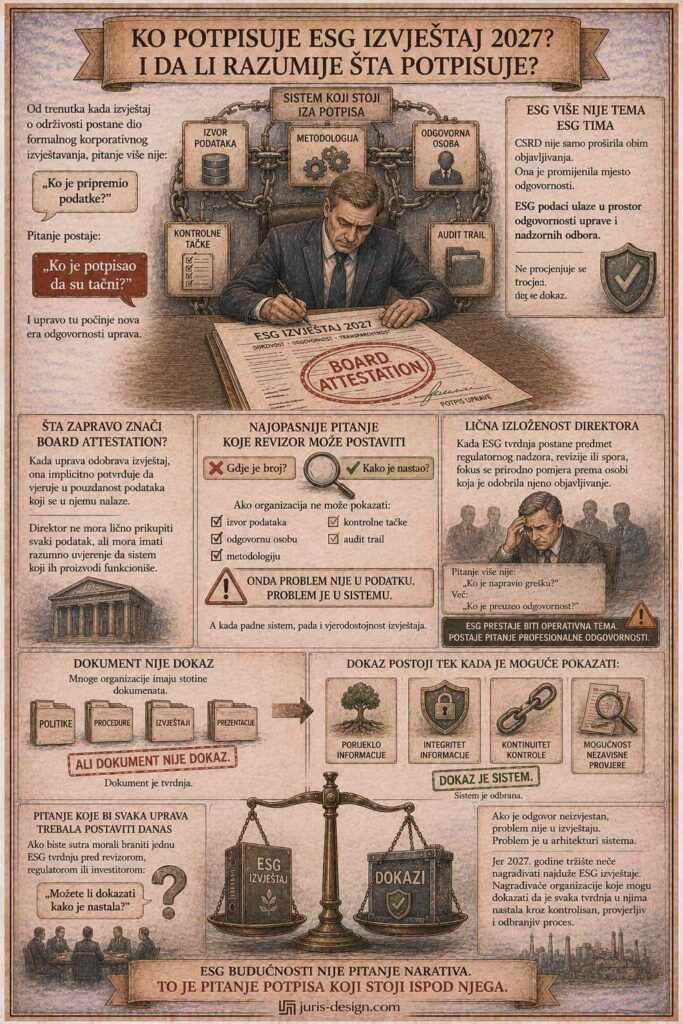
  • Ko će potpisati? CSRD i kraj kolektivne odgovornosti u regionalnim kompanijama

    Who Will Sign? CSRD and the End of Collective Responsibility in Regional Companies

    March in the Balkans is traditionally the month of closing annual accounts. But in 2026, March brings a different kind of weight.

    The question will no longer be only: “Is the company profitable?” It will be: “Who will sign the ESG report under full regulatory and governance responsibility?”

    CSRD (Corporate Sustainability Reporting Directive) introduces a fundamental shift:

    responsibility is no longer organizational — it becomes personal.

    What Is Actually Changing?

    Until now, ESG reports in many regional companies have been a combination of:

    • narratives
    • estimates
    • partial data
    • ad-hoc tables

    They were often the result of good intentions, but not of systemic structure.

    CSRD introduces a different logic.

    The ESG report becomes subject to assurance based on proof principles similar to financial reporting.

    At that moment, the question stops being: “Do we have the data?” It becomes: “Who guarantees its accuracy — and can they prove it?”

    The End of Collective Ambiguity

    In regional companies, we often hear:

    • “We are all involved in ESG.”
    • “It’s a team effort.”
    • “We’re doing it together.”

    In the Balkans, responsibility is often implicit, and processes are informal and trust-based.

    CSRD does not recognize team-based ambiguity.

    It requires:

    • Named signatories who guarantee data integrity
    • Formal controls that are documented and verifiable
    • A provable audit trail showing who approved a number, when, and on what basis

    If these structures do not exist, the regulator will not ask why the system was weak.

    They will ask who was responsible for ensuring that the system existed.

    Delegation Is Not Protection

    There is a dangerous misconception that delegating ESG to lower levels protects the Executive Management.

    On the contrary.

    In the absence of a clearly defined Proof Architecture:

    • Middle management becomes operationally blocked because it cannot prove the origin of data
    • Executive Management and the Board become legally and reputationally exposed because they sign documents without full visibility into their traceability
    • Owners become regulator-visible in the event of a negative audit opinion or enforcement measures

    If no one in the company formally signs off on partial data (energy, emissions, waste, labor rights, supplier inputs), ultimate responsibility naturally escalates to the top.

    ESG delegated to operations does not mean leadership is protected.

    In fact, it means the opposite.

    The Regional Weakness That CSRD Exposes

    The biggest challenge in the Balkans is not a lack of knowledge.

    The challenge is that systems are:

    • built for speed, not for provability
    • flexible, but undocumented
    • trust-based rather than control-based
    • often driven by “Excel culture”

    Such systems can function for years.

    But when an auditor asks:

    “Where does this number come from, and who stands behind it with their signature?”

    Improvisation is no longer enough.

    In the absence of a clear accountability architecture, three levels of risk emerge:
    Operational risk – data is inconsistent and incomparable
    Reputational risk – a negative audit opinion signals weak governance
    Governance risk – report signatories assume regulatory and personal responsibility
    CSRD does not sanction bad intent.
    It sanctions lack of control.

    Accountability Architecture as the Only Shield

    The solution is not writing longer ESG narratives.

    The solution is designing a system that protects both the organization and the individual.

    A Proof Architecture must clearly define:

    Layer 1 – Responsibility at the Source
    Operational managers formally confirm primary inputs (ERP systems, invoices, HR systems, energy measurements).

    Layer 2 – Verification Responsibility
    Control mechanisms (the “four-eyes” principle) confirm accuracy and consistency.

    Layer 3 – Traceability
    A digital trail showing every data modification over time.

    Layer 4 – Governance Responsibility
    Clear definition of who has the authority to finalize data for reporting.

    Layer 5 – Disclosure Responsibility
    Formal report sign-off with full awareness of the system behind it.

    Without these layers, every signature on an ESG report is an operational risk.

    Why This Is an Opportunity for the Balkans

    Although it sounds restrictive, CSRD is a moment of professionalization.

    Companies that, by 2026, have a clear accountability map:

    • Reduce dependence on individuals
    • Eliminate “Excel improvisation”
    • Increase credibility with EU partners
    • Protect executive management from unforeseen regulatory consequences
    • Professionalize governance structures

    In a region where reputational shocks are disproportionately strong, a clear accountability architecture becomes a competitive advantage.

    The Final Question for the March Board Meeting

    When the auditor walks into your office and asks: “Where does this number come from, and who stands behind it with their signature?”
    Do you have an answer — or do you have an excuse?

    If you cannot prove ESG, you cannot protect either the company or yourself.

    Check your exposure level with the CSRD / ESG CHECKLIST – BALKAN EDITION Download the CSRD 2026 BLUEPRINT: ESG Proof Architecture

    Other blogs

    Vrhovni sud SAD protiv izvršne vlasti: šta balkanski izvoznici moraju znati

    U.S. Supreme Court vs. the Executive Branch: what Balkan exporters need to know

    Analysis of the decision Learning Resources, Inc. v. Trump and its operational consequences...

    CSRD 2026: Pomak Omnibus I i standard dužne pažnje

    CSRD 2026: The Omnibus I Shift and the Standard of Due Diligence

    Beyond compliance: Why evidence architecture is now a legal necessity – and a personal risk…

  • CSRD Is Not an ESG Regulation. It’s a Board-Level Risk Framework.

    CSRD Is Not an ESG Regulation. It’s a Board-Level Risk Framework.

    From sustainability reporting to executive accountability.

    As organizations move toward CSRD compliance in 2026, one misconception remains widespread:
    that CSRD is primarily about ESG reporting.

    It is not.

    CSRD represents a fundamental shift in corporate accountability, moving sustainability data from marketing narratives into the realm of governance, risk, and audit exposure.

    The real question is no longer:

    “Do we report ESG data?”

    But:

    “Can we defend it — and who is personally accountable?”

    Why CSRD changes the risk profile of organizations

    CSRD introduces something many organizations were not structurally prepared for:

    • traceable data
    • named responsibility
    • auditability across the value chain

    This shifts ESG from a reputational topic to a legal and fiduciary one.

    For Boards and executives, this means:

    • ESG data becomes part of enterprise risk management
    • sustainability failures can translate into governance failures
    • accountability is no longer abstract — it is documented

    The Sarbanes–Oxley moment for ESG

    Many governance professionals compare CSRD to the Sarbanes–Oxley Act.

    Not because the regulations are identical,
    but because the impact on executive responsibility is similar.

    Just as SOX forced organizations to design financial control systems,
    CSRD forces them to design proof systems for non-financial data.

    Narratives are no longer sufficient.
    Controls, traceability, and accountability are.

    Why ESG reports fail audits

    When ESG reports fail assurance reviews, the issue is rarely inaccurate data.

    The failure happens behind the scenes:

    • unclear data origins
    • missing audit trails
    • fragmented systems
    • undefined ownership of information

    In short: the system cannot prove itself.
    Auditors do not challenge intentions.
    They challenge structures.

    ESG as a proof system, not a document

    To withstand regulatory and audit scrutiny, ESG must be designed as a proof architecture, consisting of:

    1. Data Origin Layer – where data is created and who owns it
    2. Verification Layer – how data is validated
    3. Traceability Layer – how changes are recorded
    4. Governance Layer – who approves and signs off
    5. Disclosure Layer – how information is presented to regulators and investors

    Without these layers, ESG disclosures remain vulnerable.

    The hidden exposure in the value chain

    CSRD extends accountability beyond organizational boundaries.

    A single critical supplier without:

    • standardized ESG inputs;
    • verification protocols;
    • traceability can undermine the entire reporting system.

    This makes supply chain governance one of the largest unaddressed CSRD risks globally.

    Why Boards must understand architecture, not reporting.

    CSRD is not an operational ESG task.
    It is a governance design challenge.

    Boards that focus solely on reports risk overlooking critical weaknesses.

    • structural weaknesses
    • accountability gaps
    • legal exposure

    Understanding the architecture behind ESG data is now a matter of executive protection, not sustainability strategy.

    CSRD compliance is a design question.

    Organizations that succeed under CSRD do not ask:
    “What else should we report?”

    They ask:

    “What system must we design so this data can be defended?”

    CSRD compliance is not achieved at year-end.
    It is the result of systems designed to work every day.

    If ESG cannot be proven,
    it cannot be defended.

    Download the ESG Proof Architecture 2026

    LDT ESG CHECKLIST 2026 CSRD 2026 BLUEPRINT: ESG Proof Architecture

    Other blogs

    Vrhovni sud SAD protiv izvršne vlasti: šta balkanski izvoznici moraju znati

    U.S. Supreme Court vs. the Executive Branch: what Balkan exporters need to know

    Analysis of the decision Learning Resources, Inc. v. Trump and its operational consequences...

    CSRD 2026: Pomak Omnibus I i standard dužne pažnje

    CSRD 2026: The Omnibus I Shift and the Standard of Due Diligence

    Beyond compliance: Why evidence architecture is now a legal necessity – and a personal risk…

  • CSRD and the Reality of the Balkans: Why ESG Without a System Becomes Your Biggest Hidden Risk

    CSRD and the Reality of the Balkans: Why ESG Without a System Becomes Your Biggest Hidden Risk

    As 2026 approaches, CSRD (Corporate Sustainability Reporting Directive) is often perceived in the Balkans as just another administrative requirement that “comes from above.” However, when it collides with local reality, CSRD exposes a deep systemic problem: our systems were never built for provability.

    Many regional companies today have ESG policies and Excel spreadsheets, but they lack what the directive actually requires a provable system that functions every day, not only at the moment the report is written.

    Why Does CSRD Hit the Balkans the Hardest?

    CSRD does not punish the region for being late; it exposes the fact that systems were not built on principles of traceability and auditability. Typical weaknesses that turn into risk include:

    • Excel culture: Reliance on manual processes without a digital trail.
    • Fragmented IT: Systems that do not communicate with each other.
    • The lone ESG officer: Responsibility assigned to a single person instead of an entire governance system.
    • Informal supply chains: Relationships based on trust rather than data.

    ESG Without a System: How Hidden Risk Is Created

    The greatest risk is not the lack of data, but the inability to prove its origin. When an auditor asks the question, “Where does this data come from and who guarantees it?”, the system often remains silent.

    Without a clear proof architecture, your data is merely “he said–she said” information. If the source is unknown, the auditor cannot confirm basic accuracy, leading to the principle of “Garbage in, Garbage out.”

    The Solution: ESG Proof Architecture (5 Layers of Defense)

    For regional companies, the solution is not copying EU templates, but building a structure that enables traceability. Your “defense system” must consist of five key layers:

    • Data Origin (Source of truth): Direct data from ERP systems, smart meters, or invoices. Without this, everything above is guesswork.
    • Verification (Control point): Introducing the “four-eyes” principle — person A enters the data, person B confirms its validity.
    • Traceability (Digital pedigree): A data movement map that enables reconstruction of every number back to its source.
    • Governance (Accountability layer): Signed protocols and a legal framework that guarantee system integrity. If no one signs off on the data, management bears direct legal responsibility.
    • Disclosure (Final window): Output in machine-readable XBRL format visible to regulators and banks.

    Supply Chain: Where CSRD “Breaks”

    In the Balkans, CSRD most often breaks at the supplier level. A single key partner without formal processes is enough to compromise your entire report.

    In the new 2025–2026 reality, one rule applies:

    A weak supplier = Your regulatory problem.

    An Opportunity for Professionalization

    CSRD is not just a cost; it is an opportunity to professionalize your business. Companies that build a provable system reduce long-term risk and strengthen their position in the EU market.

    Remember. If you cannot prove ESG, you cannot defend it.

    CSRD / ESG CHECKLIST – BALKAN EDITION 2026 (Montenegrin) CSRD 2026 BLUEPRINT: ESG Proof Architecture (Montenegrin)

    QUICK SELF-TEST: If an EU client asks you today:

    “Can you deliver ESG data with evidence within 48 hours?”, is your answer YES — or are you at risk?

    Other blogs

    Vrhovni sud SAD protiv izvršne vlasti: šta balkanski izvoznici moraju znati

    U.S. Supreme Court vs. the Executive Branch: what Balkan exporters need to know

    Analysis of the decision Learning Resources, Inc. v. Trump and its operational consequences...

    CSRD 2026: Pomak Omnibus I i standard dužne pažnje

    CSRD 2026: The Omnibus I Shift and the Standard of Due Diligence

    Beyond compliance: Why evidence architecture is now a legal necessity – and a personal risk…

  • CSRD 2026: Why Your ESG Checklist is an Audit Trap

    CSRD 2026: Why Your ESG Checklist is an Audit Trap

    The Illusion of “Compliance”

    Most global organizations are currently transitioning to CSRD (Corporate Sustainability Reporting Directive) using control lists (checklists). While they are excellent for identifying weaknesses, they are dangerous as the foundation for building solutions.

    As we approach the 2026 reporting cycle, the focus must shift from “Reporting” to “Proof Architecture”. If your ESG data lacks a defensible system in the background, your report is not a strategy — it is a liability and a legal exposure.

    A checklist tells you where you are vulnerable. It does not tell you what you need to build.

    I. Shifting from Narrative to Architecture

    Historically, ESG has existed within marketing and communications. CSRD has moved it to the desk of the Chief Financial Officer (CFO) and General Counsel. Regulators are no longer interested in your “sustainability story”; they are interested in your data lineage.

    Global standards (ESRS) now require:

    • Auditability: Every figure must be verifiable by a third party.
    • Traceability: A clear digital path from source to table.
    • Accountability: Board-level signatures on non-financial data.

    These are not narrative requirements — they are structural requirements.

    II. Why Global Reports Fail Audit Review

    Even companies with long ESG reporting history are increasingly facing situations where auditors reject or conditionally approve their reports. Failure rarely lies in the targets themselves — the problem is in the infrastructure.

    Common failure points include:

    • “Orphaned” data: Numbers delivered via email with no timestamp or source origin.
    • Black-box methodologies: Calculations (such as Scope 3 emissions) with no documented logical trail.
    • Governance gaps: ESG data that exists in isolated silos, disconnected from the company’s legal and financial control framework.

    The problem is not the content — the problem is the architecture that produces it.

    III. The Blueprint: ESG as a System, Not a Document

    To pass assurance with limited or reasonable confidence, ESG must be structured as a five-layer defense system:

    • Data Origin: Direct data sources (ERP, IoT) replacing manual estimates.
    • Verification: Automated logical controls that detect anomalies before they reach the report.
    • Traceability: A digital “pedigree” for every data point.
    • Governance: Formal ownership of data and clearly assigned legal risk.
    • Disclosure: Transformation of raw inputs into machine-readable XBRL formats for global regulators.

    Without these five layers, your ESG report is simply a collection of claims that cannot be defended in court or at a board meeting.

    IV. The Fracture Point: Supply Chain

    For global entities, CSRD breaks in the supply chain. A single key supplier without a verifiable data system can compromise the report of an entire Group.

    Your architecture must extend beyond your internal systems. The Blueprint applies equally to standardized supplier inputs as it does to your internal ERP.

    V. Blueprinting vs Implementation

    A Blueprint is not your IT software, nor your legal advisor. It is the Master Plan that directs them.

    Without a Blueprint:

    • Costs escalate: You purchase software that “does not speak” to your auditors.
    • Complexity paralyzes: Departments operate in silos, creating redundant data.
    • Risk remains hidden: Gaps surface only when the auditor asks the first question.

    CSRD compliance is not a reporting exercise. It is a systems-design challenge. In the regulatory environment of 2026, the rule is simple: If you cannot prove it — you cannot defend it.

    As a practical extension of this article, I have prepared the ESG Proof Architecture.

    Download ESG PROOF ARCHITECTURE GLOBAL

    LDT ESG CHECKLIST 2026 CSRD 2026 BLUEPRINT: ESG Proof Architecture

    Other blogs

    Vrhovni sud SAD protiv izvršne vlasti: šta balkanski izvoznici moraju znati

    U.S. Supreme Court vs. the Executive Branch: what Balkan exporters need to know

    Analysis of the decision Learning Resources, Inc. v. Trump and its operational consequences...

    CSRD 2026: Pomak Omnibus I i standard dužne pažnje

    CSRD 2026: The Omnibus I Shift and the Standard of Due Diligence

    Beyond compliance: Why evidence architecture is now a legal necessity – and a personal risk…

  • CSRD 2026 BLUEPRINT — From ESG Reporting to Proof Architecture

    CSRD 2026 BLUEPRINT — From ESG Reporting to Proof Architecture

    Why a checklist is no longer enough.

    Most companies are entering 2026 with a task list. The problem is that a checklist only shows where you are vulnerable, but it does not tell you what you need to build in order to close those gaps.

    CSRD (Corporate Sustainability Reporting Directive) does not ask you for a better essay or a prettier annual report. CSRD requires a provable system. The difference between “we have data” and “we have a provable system” is the difference between passing and failing an audit.

    That is why today we are not talking about a document. We are talking about a Blueprint.

    I. What CSRD actually requires (and why many misunderstand it)

    CSRD is often, and incorrectly, perceived as just another set of ESG templates. In reality, the regulator is not asking for a narrative, but for systemic attributes:

    • Auditability: Can an external auditor trace every single number?
    • Traceability: Where was the data before it entered the table?
    • Comparability: Are your data points consistent with industry standards?
    • Proven accountability: Who, by name and surname, guarantees the integrity of the information?

    These are not textual requirements. These are architectural requirements.

    II. Why ESG reports fail in audit

    When audit firms (including “Big Four” firms) refuse to issue a positive opinion on an ESG report, the reason rarely lies in the numbers themselves. The problem is in the “background”:

    • Data without pedigree: The data “arrived by email” without a clear source.
    • ESG “stories” without an audit trail: The sustainability narrative has no digital signature to support it.
    • Supply chain “black holes”: Supplier data is collected ad-hoc, without quality control. The problem is not the content. The problem is the architecture that generates that content.

    III. CSRD Blueprint: ESG as a system, not a file

    For ESG to be defensible, it must be structured across five layers of provability:

    • Data Origin Layer: The exact point of data creation (sensor, invoice, HRM system) and a clearly defined responsible person.
    • Verification Layer: The protocol by which that data is verified before it enters the system.
    • Traceability Layer: A digital trail that enables tracking changes to the data over time.
    • Governance Layer: A clear structure of who signs, who approves, and who bears legal responsibility for accuracy.
    • Disclosure Layer: The final output adapted for investors and regulators (XBRL formatting).

    Without these layers, your ESG report is only a collection of claims that nobody can confirm.

    IV. Why the supply chain is the critical breaking point

    CSRD does not end at your company’s doors. It breaks at your suppliers.

    A single key supplier without clear inputs and an audit trail is enough to compromise your entire system.

    The Blueprint therefore must not be closed inside your IT environment — it must define communication standards with external partners.

    V. The Blueprint is not implementation — but without it, implementation makes no sense

    It is important to understand: the Blueprint does not replace your lawyers, auditors, or IT providers. It is the master plan that gives them direction.

    Without a Blueprint:

    • Implementation becomes chaotic: Every department works in its own way.
    • Costs increase: You purchase software that cannot communicate with each other.
    • Risk remains invisible: You will discover the system does not work only when the auditor asks the first question.

    CSRD compliance is not a question of reporting at the end of the year. It is a question of designing a provability system that operates 365 days a year.

    If you cannot prove ESG — you cannot defend it.

    Download ESG Proof Architecture 2026 Balkan Edition

    CSRD / ESG CHECKLIST – BALKAN EDITION 2026 (Montenegrin) CSRD 2026 BLUEPRINT: ESG Proof Architecture (Montenegrin)

    Other blogs

    Vrhovni sud SAD protiv izvršne vlasti: šta balkanski izvoznici moraju znati

    U.S. Supreme Court vs. the Executive Branch: what Balkan exporters need to know

    Analysis of the decision Learning Resources, Inc. v. Trump and its operational consequences...

    CSRD 2026: Pomak Omnibus I i standard dužne pažnje

    CSRD 2026: The Omnibus I Shift and the Standard of Due Diligence

    Beyond compliance: Why evidence architecture is now a legal necessity – and a personal risk…

  • Global ESG Risk Escalation

    Global ESG Risk Escalation

    Why CSRD Becomes the Golden Standard for Global Valuation

    Companies around the world still view ESG as a regulatory trend coming from Europe.
    That perception is wrong.

    With the implementation of the CSRD directive (Corporate Sustainability Reporting Directive), ESG ceases to be voluntary and becomes a globally measurable, legally binding system.

    This is not a European problem. This is a global business validation model.

    I. Who Is at Risk: Geography No Longer Protects

    Although CSRD formally comes from the European Union, its impact is extraterritorial. Direct obligation (EU market – from 2026)

    CSRD applies to:

    • Large EU companies;
    • Non-EU companies generating significant revenue in the EU;

    If you operate in the EU market – CSRD applies to you.

    2. Indirect obligation (global supply chain)

    Multinational companies will require ESG data from:

    • Suppliers in Asia;
    • Manufacturers in Latin America;
    • IT and service partners worldwide.

    If your client must prove ESG compliance – you must provide proof.

    Non-compliance means:

    • loss of contracts;
    • Exclusion from the supply chain;
    • Global reputational risk.

    3. Greenwashing as a Global Legal Risk

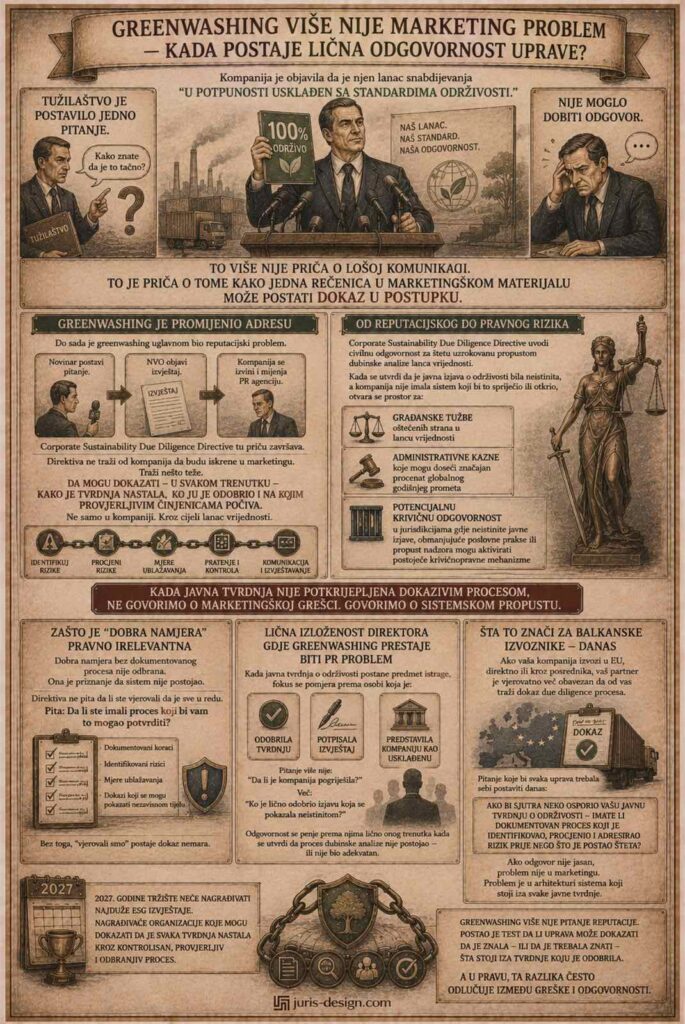
    Unverifiable ESG claims are no longer just a marketing problem.

    Regulators (SEC, FTC, EU Commission) actively sanction:

    • Unprovable “green” claims;
    • Non-auditable ESG reports.

    Greenwashing becomes a universal legal risk.

    II. The Real Problem: Lack of Visual Auditability

    Most companies misdiagnose the ESG problem.

    The problem is not:

    • Too many standards;
    • Too much data;
    • Too much regulation.

    The problem is a fragmented, invisible proof system.

    Global ESG data comes from different jurisdictions, processes, and standards, creating three key vulnerabilities:

    • Data is collected locally;
    • No unified inputs;
    • Manual processes introduce errors.

    2. Legal vulnerability

    Auditors require:

    • Comparability;
    • Traceability;
    • Clear audit trail.

    Textual reports cannot provide this.

    3. Weak link: Supply chain

    One non-compliant supplier can:

    • Compromise the entire corporation;
    • Jeopardize regulatory compliance;
    • Trigger legal and reputational risk.

    III. The LDT solution: ESG as a protocol, not a document

    Legal Design Thinking (LDT) transforms ESG from narrative into a functional system. Visual ESG Dashboard

    Centralized control panel that:

    • Consolidates global ESG metrics;
    • Shows the source of each data point;
    • Allows instant auditing.

    Result: global auditability.

    2. Layered Transparency

    Instead of one massive report:

    • Visual ESG summary for investors;
    • Full technical documentation for auditors.

    Transparency without overload.

    3. ESG Protocol for the Global Supply Chain

    Visual LDT tools for suppliers:

    • Standardized ESG checklists;
    • Plain language questionnaires;
    • Comparable source data.

    This ensures:

    • Closing greenwashing gaps;
    • Reducing regulatory risk;
    • Strengthening the entire chain.

    Visualization Becomes the New Currency of Trust

    In 2026, ESG is no longer a matter of intent, but of proof.

    Companies unable to display their ESG performance:

    • Visually;
    • Clearly;
    • Auditably

    Will be:

    • Discounted in valuation;
    • Exposed to legal risk;
    • Excluded from key value chains

    LDT does not simplify the law. It makes it provable.

    If your ESG data is not visual and auditable, can it even be legally sustainable?

    Download LDT ESG CHECKLIST

    Other blogs

    Vrhovni sud SAD protiv izvršne vlasti: šta balkanski izvoznici moraju znati

    U.S. Supreme Court vs. the Executive Branch: what Balkan exporters need to know

    Analysis of the decision Learning Resources, Inc. v. Trump and its operational consequences...

    CSRD 2026: Pomak Omnibus I i standard dužne pažnje

    CSRD 2026: The Omnibus I Shift and the Standard of Due Diligence

    Beyond compliance: Why evidence architecture is now a legal necessity – and a personal risk…

ENG