Do You Export to the EU?
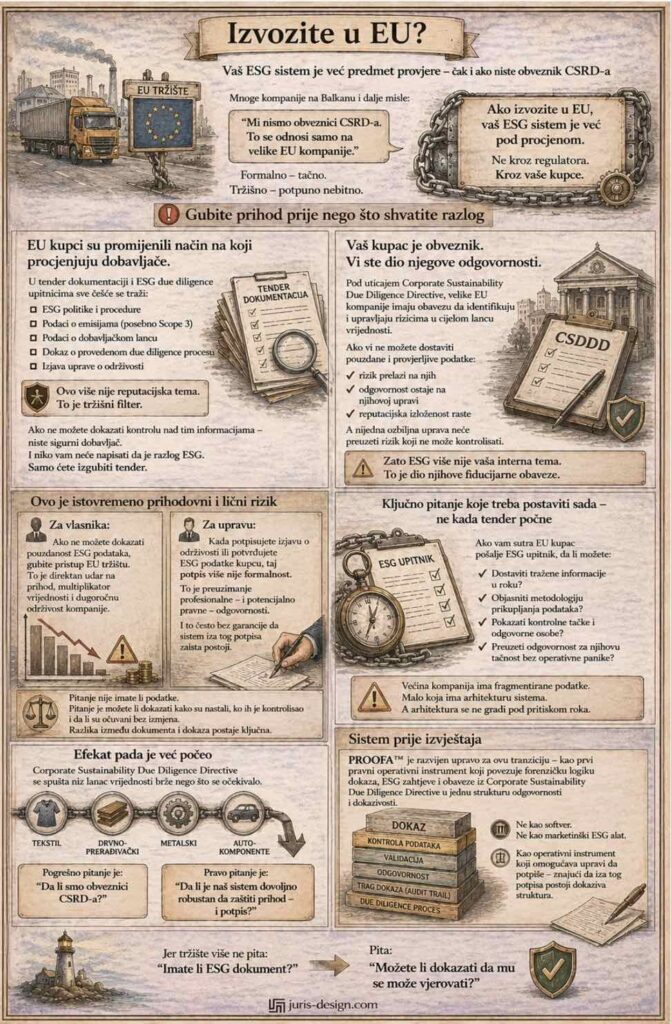
Your ESG system is already under review – even if you are not subject to CSRD. Many companies in the Balkans still believe: “We are not subject to CSRD. It only applies to large EU companies.” Formally – correct. From a market perspective – completely irrelevant. If you export to the EU, your ESG system is already being assessed. Not by regulators. By your customers.
You are losing revenue before you even understand why. EU buyers have changed the way they evaluate suppliers. Tender documentation and ESG due diligence questionnaires increasingly require:
- ESG policies and procedures
- Emissions data (especially Scope 3)
- Supply chain data
- Proof of implemented due diligence processes
- Management sustainability statements
This is no longer a reputational issue. It is a market filter. If you cannot demonstrate control over this information – you are not a reliable supplier. And no one will tell you ESG is the reason. You will simply lose the tender.
Your customer is the obligated party. You are part of their responsibility.
Under the Corporate Sustainability Due Diligence Directive, large EU companies are required to identify and manage risks across their entire value chain.
If you cannot provide reliable and verifiable data:
- the risk transfers to them
- the responsibility remains with their management
- reputational exposure increases
And no serious management team will accept a risk it cannot control. That is why ESG is no longer your internal issue. It is part of their fiduciary duty.
This is simultaneously a revenue risk and a personal risk.
For the owner:
If you cannot prove the reliability of ESG data, you lose access to the EU market. That is a direct impact on revenue, value multiplier, and the long-term sustainability of the company.
For management:
When you sign a sustainability statement or confirm ESG data to a customer, that signature is no longer a formality. It is the assumption of professional – and potentially legal – responsibility. And often without any guarantee that the system behind that signature actually exists. The question is not whether you have the data. The question is whether you can prove how it was created, who controlled it, and whether it was preserved without alteration. The distinction between a document and evidence becomes critical.
The key question that must be asked now – not when the tender begins
If an EU customer sends you an ESG questionnaire tomorrow, can you:
- Provide the requested information on time?
- Explain the methodology of data collection?
- Show control points and responsible persons?
- Take responsibility for its accuracy without operational panic?
Most companies have fragmented data. Very few have system architecture. And architecture is not built under deadline pressure.
The cascading effect has already begun
The Corporate Sustainability Due Diligence Directive is moving down the value chain faster than expected. Companies in the textile, wood-processing, metal, and auto-component sectors across the Balkans are already feeling it.
The wrong question is:
“Are we subject to CSRD?”
The real question is:
“Is our system robust enough to protect revenue – and the signature?”
System before reporting
As sustainability reporting frameworks - including those introduced under the Corporate Sustainability Reporting Directive - move toward progressively stronger assurance expectations, systems will not be evaluated only on outputs.
They will be evaluated on architecture.
When ESG data flows across departments, suppliers, spreadsheets, external consultants and digital tools, integrity becomes fragmented.
Audit logs remain.
Control logic often does not.
When Governance Meets Evidence
PROOFA™ Evidence Architecture™ was developed precisely for this transition – as the first legal-operational instrument connecting forensic evidence logic, ESG requirements, and obligations under the Corporate Sustainability Due Diligence Directive into one structure of accountability and defensibility. Not as software. Not as a marketing ESG tool. As an operational instrument that allows management to sign – knowing that a defensible structure exists behind that signature.
Because the market no longer asks:
“Do you have an ESG document?”
It asks:
“Can you prove it can be trusted?”
Other blogs


Cost of an unprovable corporate claim
The contract was not renewed. The notification came in three lines. The company was convinced that...
You can lose a tender before anyone even cites ESG as the reason.
The formal notification came in three lines. The company was sure that the price was…