The Company That Can Prove Its Decisions Has a Different Risk Profile
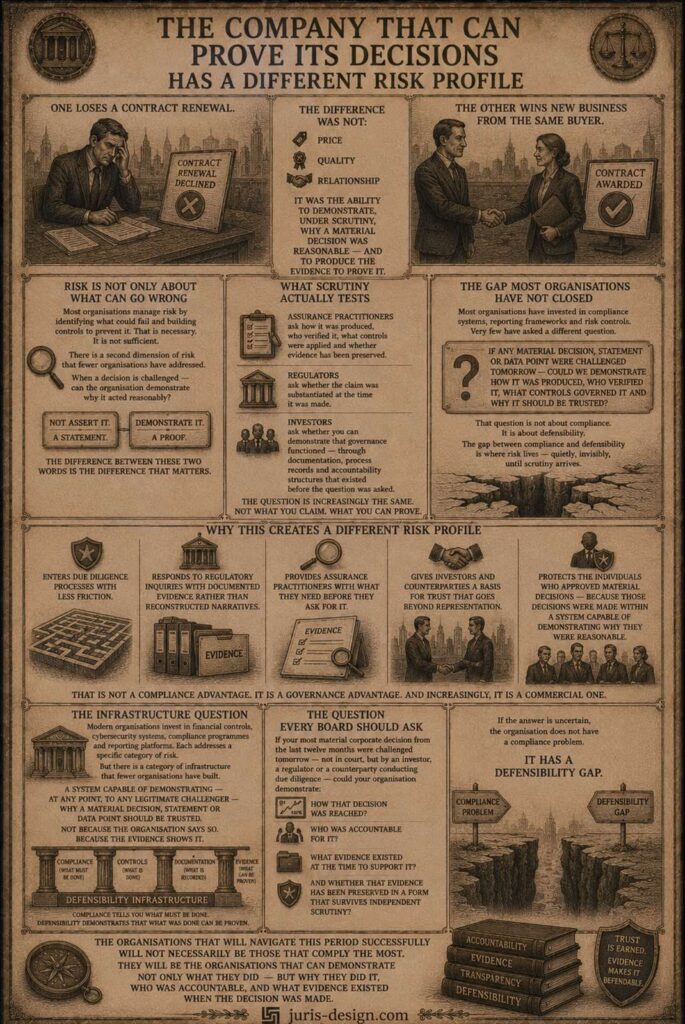
One loses a contract renewal. The other wins new business from the same buyer. The difference was not price. It was not quality. It was not relationship.
It was the ability to demonstrate, under scrutiny, why a material decision was reasonable — and to produce the evidence to prove it.
Risk Is Not Only About What Can Go Wrong
Most organisations manage risk by identifying what could fail and building controls to prevent it. That is necessary. It is not sufficient. There is a second dimension of risk that fewer organisations have addressed.
When a decision is challenged — by an investor, a regulator, a counterparty, an assurance practitioner — can the organisation demonstrate why it acted reasonably?
Not assert it. Demonstrate it. The difference between those two words is the difference between a statement and a proof.
And in a business environment where sustainability disclosures, AI-assisted decisions, supply chain representations and board statements are increasingly subject to independent scrutiny, that difference carries economic consequences.
What Scrutiny Actually Tests
When a material corporate decision comes under scrutiny, the question is rarely whether the decision was correct.
It is whether the process that produced it was controlled, documented and defensible. An assurance practitioner does not ask whether your Scope 3 number looks reasonable. They ask how it was produced, who verified it, what controls were applied and whether the evidence has been preserved. A regulator investigating a greenwashing claim does not ask whether you intended to mislead.
Among other questions, they ask whether the claim was substantiated at the time it was made — though the precise standard will depend on the applicable jurisdiction and regulatory framework.
An investor conducting due diligence does not ask whether your governance appears sound. They ask whether you can demonstrate that it functioned — through documentation, process records and accountability structures that existed before the question was asked.
In each case, the underlying question is increasingly the same. Not what you claim. What you can prove.
The Gap Most Organisations Have Not Closed
Most organisations have invested significantly in compliance systems, reporting frameworks and risk controls. Very few have asked a different question.
If any material decision, statement or data point in our corporate reporting were challenged tomorrow — could we demonstrate how it was produced, who verified it, what controls governed it and why it should be trusted?
That question is not about compliance. It is about defensibility. And the gap between compliance and defensibility is where risk lives — quietly, invisibly, until scrutiny arrives.
Why This Creates a Different Risk Profile
An organisation that can demonstrate the defensibility of its decisions operates differently from one that cannot. It enters due diligence processes with less friction. It responds to regulatory inquiries with documented evidence rather than reconstructed narratives. It provides assurance practitioners with what they need before they ask for it.
It gives investors and counterparties a basis for trust that goes beyond representation. It protects the individuals who approved material decisions — because those decisions were made within a system capable of demonstrating why they were reasonable. That is not a compliance advantage. It is a governance advantage. And increasingly, it is a commercial one.
The Infrastructure Question
Modern organisations invest in financial controls, cybersecurity systems, compliance programmes and reporting platforms. Each addresses a specific category of risk. But there is a category of infrastructure that fewer organisations have built. A system capable of demonstrating — at any point, to any legitimate challenger — why a material corporate decision, statement or data point should be trusted. Not because the organisation says so. Because the evidence shows it.
That infrastructure does not replace compliance. It completes it. Because compliance tells an organisation what must be done. Defensibility infrastructure demonstrates that what was done can be proven.
The Question Every Board Should Ask
If your most material corporate decision from the last twelve months were challenged tomorrow — not in court, but by an investor, a regulator or a counterparty conducting due diligence — could your organisation demonstrate:
- How that decision was reached?
- Who was accountable for it?
- What evidence existed at the time to support it?
- And whether that evidence has been preserved in a form that survives independent scrutiny?
If the answer is uncertain, the organisation does not have a compliance problem. It has a defensibility gap. And in a business environment where the scrutiny of corporate decisions is becoming more systematic, more rigorous and more consequential — that gap has a cost. The organisations that will navigate this period successfully will not necessarily be those that comply the most. They will be the organisations that can demonstrate not only what they did — but why they did it, who was accountable, and what evidence existed when the decision was made. That is defensibility.
Other blogs


Cost of an unprovable corporate claim
The contract was not renewed. The notification came in three lines. The company was convinced that...
You can lose a tender before anyone even cites ESG as the reason.
The formal notification came in three lines. The company was sure that the price was…