Scope 3 Data: The Reason You Can Lose an EU Customer Before You Understand Why
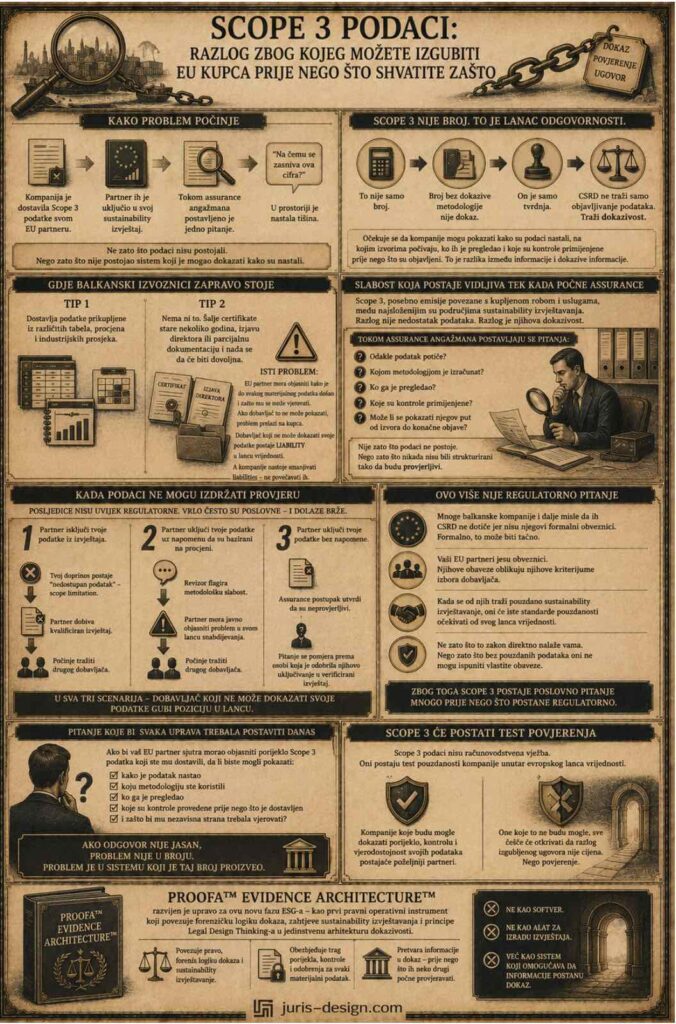
The company submitted Scope 3 data to its EU partner. The partner included it in its sustainability report. During the assurance engagement, one question was asked. “What is this figure based on?” Silence filled the room. Not because the data did not exist. But because there was no system that could prove how it was generated.
Scope 3 is not a number. It is a chain of accountability. Most Balkan exporters view Scope 3 as a calculation. You add up supplier emissions, add transportation, apply the appropriate emission factors, and get a number that goes into the report.
But Scope 3 is not just a number. A number without a defensible methodology is not evidence. It is only a claim. The Corporate Sustainability Reporting Directive does not only require data disclosure. As sustainability reporting and assurance requirements mature, companies are expected to be able to demonstrate how the data was generated, what sources it is based on, who reviewed it, and what controls were applied before it was disclosed. That is the fundamental difference between information and defensible information.
Where Balkan Exporters Actually Stand
Today, two types of exporters are most commonly encountered in practice. The first provides data collected from different spreadsheets, estimates and industry averages.
The second does not even have that. It sends certificates that are several years old, a director’s statement or partial documentation and hopes it will be sufficient. Both approaches have the same problem. An EU partner preparing a sustainability report must be able to explain how it arrived at every material data point and why it can be trusted. If the supplier cannot demonstrate this, the problem is no longer only on the supplier’s side. The problem moves to the buyer that includes that data in its own report. A supplier that cannot prove its data becomes a liability in the value chain. And companies seek to reduce liabilities - not increase them.
The Weakness That Becomes Visible Only When Assurance Begins
Scope 3, particularly emissions associated with purchased goods and services, is among the most complex areas of sustainability reporting. The reason is not a lack of data. The reason is its defensibility. During an assurance engagement, attention is not focused only on the number. Questions such as these are asked:
- Where does the data originate?
- What methodology was used to calculate it?
- Who reviewed it?
- What controls were applied?
- Can its path from source to final disclosure be demonstrated?
It is precisely on these questions that many systems begin to show their weaknesses. Not because the data does not exist. But because it was never structured to be verifiable.
When Data Cannot Withstand Scrutiny
The consequences are not always regulatory. Very often they are commercial - and they come faster. An EU partner may conclude that the submitted data is not sufficiently reliable to include in the report. It may classify it as an estimate with additional explanations. It may request extensive supplementary documentation. Or it may conclude that it is simpler to find a supplier with better-quality information.
In concrete scenarios, it looks like this:
The partner excludes your data from the report. Your contribution becomes “unavailable data” - a scope limitation in assurance terminology. The partner receives a qualified report. It begins looking for another supplier. The partner includes your data with a note that it is estimate-based. The auditor flags a methodological weakness. The partner must publicly explain the issue in its supply chain. It begins looking for another supplier. The partner includes your data without a note. The assurance process determines that it cannot be verified. The question moves toward the person who approved its inclusion in the verified report.
In all three scenarios - a supplier that cannot prove its data loses its position in the chain.
This Is No Longer a Regulatory Question
Many Balkan companies still believe that CSRD does not affect them because they are not formal CSRD obligations. Formally, that may be true. From a market perspective, it means less and less. Your EU partners are subject to the requirements. Their obligations shape their supplier selection criteria. When they are required to provide reliable sustainability reporting, they will expect the same reliability standards from their value chain. Not because the law directly imposes this on you. But because without reliable data, they cannot fulfil their own obligations. That is why Scope 3 becomes a business issue long before it becomes a regulatory one.
The Question Every Board Should Ask Today If your EU partner had to explain the origin of the Scope 3 data you provided tomorrow, would you be able to demonstrate:
- how the data was generated
- which methodology you used
- who reviewed it
- which controls were carried out before it was submitted
- and why an independent party should trust it?
If the answer is unclear, the problem is not the number. The problem is the system that produced that number.
Scope 3 Will Become a Test of Trust
Scope 3 data is not an accounting exercise. It is becoming a test of a company’s reliability within the European value chain. Companies that can demonstrate the origin, control and credibility of their data will become more desirable partners. Those that cannot will increasingly discover that the reason they lost a contract was not price. It was trust.
PROOFA™ Evidence Architecture™ was developed precisely for this new phase of ESG - as the first legal-operational instrument that connects the forensic logic of evidence, sustainability reporting requirements and the principles of Legal Design Thinking into a unified defensibility architecture. Not as software. Not as a reporting tool. But as a system that enables information to become evidence before someone else starts examining it.
Other blogs


You don't lose an EU contract because of ESG. You lose it because the buyer can't prove they trust you.
Notification of the outcome of the tender was received by e-mail. Short. Formal. No explanation...
A company that can prove its decisions has a different risk profile
One loses contract renewal. The other gets new business from the same customer. The difference wasn't in...