When Evidence Becomes Infrastructure
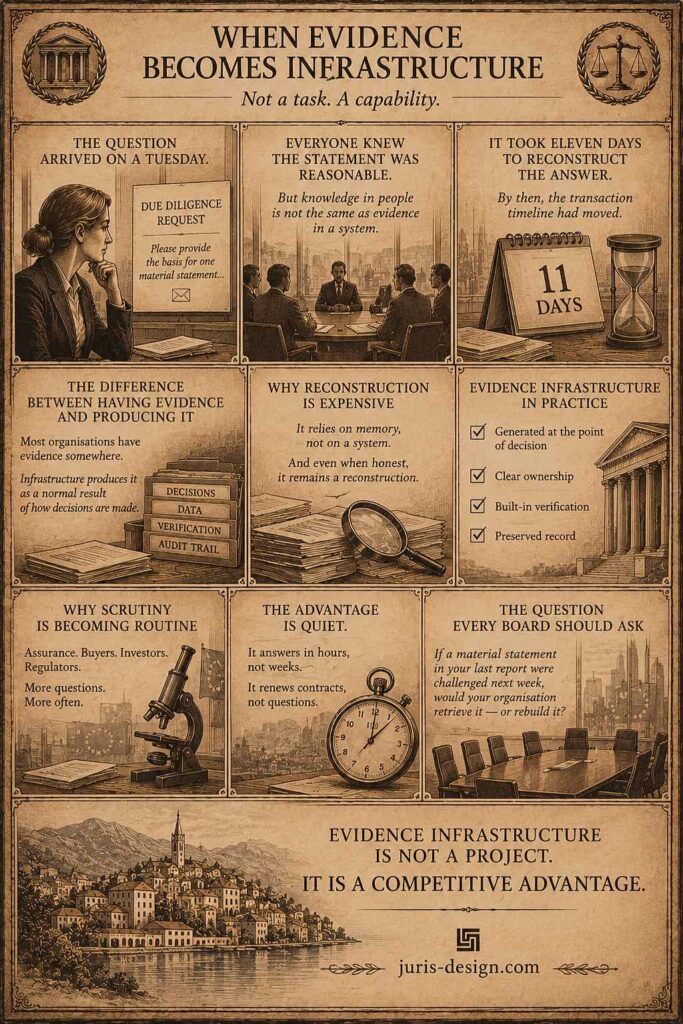
The question arrived on Tuesday. The contracting party conducting the due diligence requested the basis for a material claim from the company's report. Everyone in the company knew that the claim was reasonable. The finance team knew where the data came from. The person in charge of sustainability remembered the methodology. The director remembered approving the claim. But that knowledge was in the people, not in the system. It took eleven days to reconstruct the response. By then, the timeline of the transaction had already changed.
The Difference Between Having Evidence and Producing It
Most organisations have evidence somewhere. In emails. In spreadsheets. In the memory of the people who were in the room. That is not the same as having a system that produces evidence as a normal result of how decisions are made. The first can be assembled when someone asks.
The second exists before anyone does. The difference is not visible in normal operations. It becomes visible when the question arrives, and the organisation has to choose between reconstructing the answer and simply producing it.
How Organisations Treat Their Other Critical Capabilities
Modern organisations do not rebuild their financial controls every time an auditor visits. They do not assemble cybersecurity from scratch after an incident. Those capabilities are infrastructure. They run continuously, in the background, as part of how the organisation operates. Nobody asks whether financial controls are a project or a reaction.
They are a permanent condition of operating. Evidence is rarely treated that way. It is still treated as a task that begins when scrutiny begins: collect, compile, explain.
Why Reconstruction Is the Expensive Option
Evidence assembled after the fact carries a cost that evidence produced at the time does not. People must remember what happened. Records must be found, matched and dated. Versions must be reconciled. Decisions must be explained by people who may no longer be in the organisation.
And even when the reconstruction is honest and careful, it remains a reconstruction. An independent party has no way to tell it apart from a convenient narrative unless something contemporaneous supports it. That is why the timing of evidence matters as much as its content.
What Infrastructure Means in Practice
Evidence becomes infrastructure when four things are true. It is generated at the point where information or a decision is created, not afterwards. Ownership is clear: someone is accountable for every material data point and statement. Verification is built into the process, not added at the end. And the record is preserved in a form that shows what existed at the time the decision was made.
None of this requires a particular technology. It requires a decision that defensibility is part of how the organisation operates, and not something it prepares for once a year.
Why Scrutiny Is Becoming Routine
The occasions on which organisations must substantiate their claims are no longer rare. Assurance engagements are expanding. Buyers are asking suppliers for evidence. Investors and counterparties are examining governance during due diligence. Regulators are looking more closely at public claims. Each of these is a moment when an organisation is asked to demonstrate, not to assert.
When those moments are occasional, reconstruction is an inconvenience. When they become routine, reconstruction becomes a standing cost. At that point, building the capability once is cheaper than rebuilding the answer every time.
The Advantage Is Quiet
An organisation with this infrastructure does not look different from the outside. Its reports look similar. Its policies look similar. The difference shows in what happens when a question arrives. It answers in hours rather than weeks.
It does not depend on who remembers what. It does not discover gaps while being asked about them. That difference rarely appears in a headline. It appears in the speed of a due diligence process, in the absence of a qualified finding, in a contract that renews.
The Question Every Board Should Ask
If a material statement in your last annual report were challenged next week, how would your organisation produce the answer? Would it retrieve it? Or would it rebuild it?
If the honest answer is that it would rebuild it, the organisation does not yet have evidence infrastructure. It has evidence that depends on who is still available to explain it. And infrastructure, by definition, does not depend on that.
Other blogs


Evidence Is Most Expensive to Reconstruct Once It Is Gone
Can your company explain the decision it made three years ago? The question has arrived…
When Evidence Becomes Infrastructure
The question arrived on Tuesday. The contractual party that conducted the due diligence requested...