Greenwashing is no longer a marketing problem - when does it become personal liability for management?
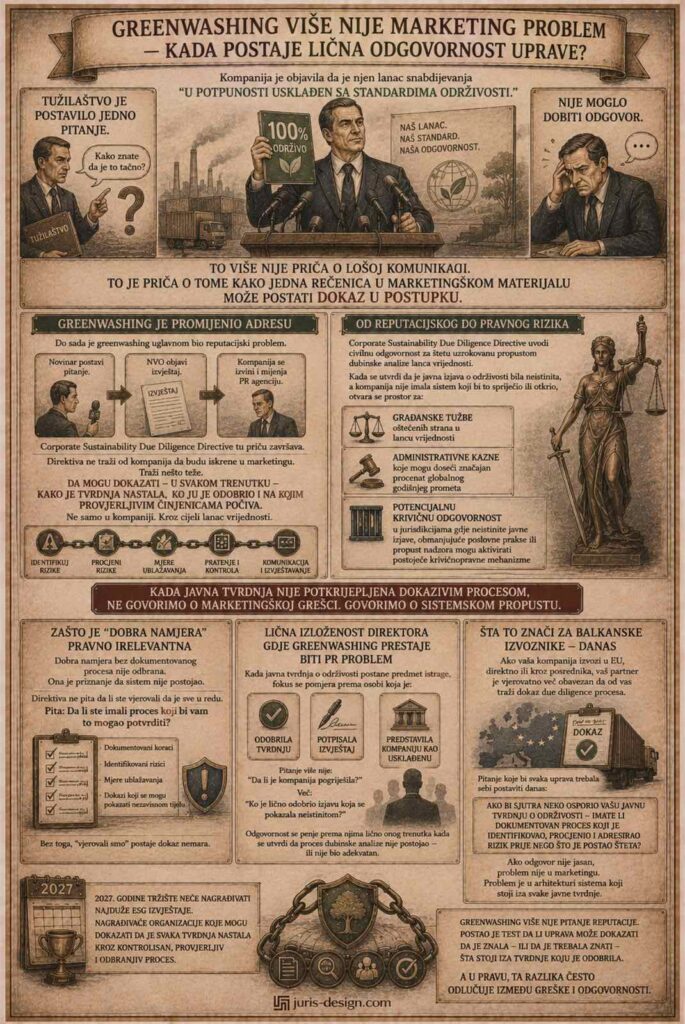
The company stated that its supply chain was “fully aligned with sustainability standards.”
The prosecutor asked a single question.
There was no answer.
This is no longer a story about poor communication.
It is a story about how one sentence in marketing material can become evidence in a legal proceeding.
Greenwashing has changed its address
Until now, greenwashing was mainly a reputational issue.
A journalist asks a question.
An NGO publishes a report.
The company apologizes and changes its PR agency.
The Corporate Sustainability Due Diligence Directive ends that story.
The directive does not ask companies to be honest in marketing.
It asks something harder.
To be able to prove - at any moment - how a claim was formed, who approved it, and on what verifiable facts it is based.
Not only within the company.
Across the entire value chain.
When a company publicly claims it complies with sustainability standards but cannot show evidence of due diligence behind that claim, we are no longer talking about a marketing error.
We are talking about a systemic failure.
And systemic failures have legal consequences.
From reputational to legal risk
This is the point that most Balkan exporters to the EU market have not yet understood.
The Corporate Sustainability Due Diligence Directive introduces civil liability for damage caused by failures in value chain due diligence.
But the practical consequences go much further.
When it is established that a public sustainability statement was false, and the company did not have a system capable of preventing or detecting it, the door opens to:
- civil lawsuits from affected parties in the value chain
- administrative penalties that can reach a significant percentage of global annual turnover
- potential criminal liability in jurisdictions where false public statements, misleading business practices, or failure of oversight can trigger existing criminal law mechanisms
For an exporter from the Balkans, this is not an abstract threat from Brussels.
This is a risk that travels through contracts.
With every EU partner who is required to apply due diligence across their entire supply chain - including you.
Why “good faith” is legally irrelevant
Directors often believe they are protected by good intentions.
“We believed the supplier was compliant.”
“We did not know about the violation.”
“We acted in good faith.”
Legally speaking, good faith without a documented process is not a defense.
It is an admission that no system existed.
The Corporate Sustainability Due Diligence Directive does not ask whether you believed everything was fine.
It asks:
“Did you have a process that could confirm it?”
With documented steps.
Identified risks.
Mitigation measures.
And evidence that can be shown to an independent body.
If that process does not exist, the claim of “belief” stops being protection.
It becomes evidence of negligence.
Personal exposure of directors - when greenwashing stops being a PR issue
This is where greenwashing changes category.
When a public sustainability claim becomes the subject of an investigation, the focus does not stop at the company.
It shifts toward the individual who:
- approved the claim
- signed the report
- presented the company as compliant
This is the moment when the question changes from:
“Did the company make a mistake?”
to:
“Who personally approved a statement that turned out to be false?”
Directors who are used to responsibility staying at the level of the legal entity are facing a new reality:
Responsibility moves upward to them personally once it is established that no adequate due diligence process existed.
What this means for Balkan exporters - today
If your company exports to the EU, directly or through an intermediary, your partner is likely already required to obtain evidence of your due diligence process.
Not a statement. Evidence.
The question every board should ask today:
If your public sustainability claim were challenged tomorrow - do you have a documented process that identified, assessed, and addressed the risk before it became harm?
If the answer is unclear, the problem is not marketing.
The problem is the system architecture behind every public claim.
Greenwashing is no longer a communication style issue
The 2027 market will not punish companies that poorly communicate sustainability.
It will punish companies that cannot prove that behind every claim there was a process capable of verifying it - before someone else does.
Greenwashing is no longer a reputational issue.
It has become a test of whether management can prove it knew - or should have known - what stands behind the claim it approved.
And in law, that difference often decides between mistake and liability.
Other blogs


Cost of an unprovable corporate claim
The contract was not renewed. The notification came in three lines. The company was convinced that...
You can lose a tender before anyone even cites ESG as the reason.
The formal notification came in three lines. The company was sure that the price was…