CSRD 2026 and the Balkans: Postponement Is Not Relief
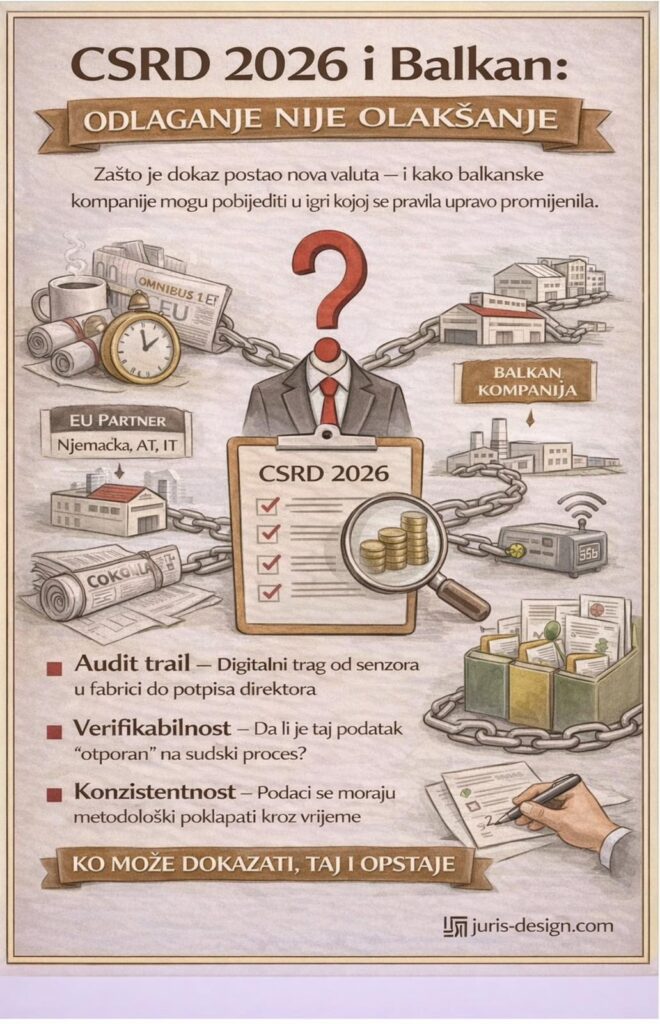
Why proof has become the new currency - and how Balkan companies can win in a game whose rules have just changed.
While Balkan directors and compliance officers were waking up with their morning coffee at the beginning of March, a decision was made in Brussels that made many breathe a sigh of relief - and the wiser ones think deeply. This change comes through the so-called Omnibus I package, through which the European Union simplifies rules related to sustainability reporting. The directive entered into force on March 19, 2026 and drastically raised the thresholds for CSRD reporting. If you think this is the “end of the headache” - you are mistaken.
1. The big threshold cleaning: Who's out, who's in?
The new thresholds are high: companies with more than 1,000 employees and turnover exceeding 450 million euros. For a region like the Balkans, this means that only the “heavyweights” will report directly - power utilities, telecoms and the largest industrial systems. However, this is where what I would call a legal boomerang appears.
The pressure of responsibility flows down the entire supply chain - even when you are not required to report.
Even if you are not required to write a 200-page report for Brussels, your partners in Germany, Austria or Italy are. And they will transfer every gram of their responsibility onto you.
“You did not ask whether I am allowed to request this data from you. I asked him: can you afford not to provide it?”
2. The Balkan paradox: Less law, more forensics
As a lawyer working at the intersection of law and system design, I rarely see the problem in the law - I almost always see it in the fact that the law has not been translated into a process.
Past practice in the region has often come down to “creative writing” of ESG strategies. That is dead letter on paper. With the new amendments, the EU focus shifts from the quantity of reports to the integrity of data. I see this as a transition to evidence forensics. Your European partner no longer asks for your statement that you do not pollute the river.
WHAT YOUR EU PARTNER IS ACTUALLY ASKING FOR
- Audit Trail - A digital trace from the sensor in the factory to the director’s signature. Every step documented, time-stamped, immutable.
- Verifiability - Is that data “resistant” to a court proceeding? If tomorrow you are accused of greenwashing, where is your proof?
- Consistency - Data from Q1 must be methodologically aligned with data from Q4. Inconsistency is the first gap through which an auditor enters.
3. Shield for SMEs: The Value-Chain Cap
One of the few real victories for Balkan small and medium-sized enterprises in Omnibus I is the introduction of a limitation of requests within the supply chain. Large players from the EU are no longer allowed to “harass” small suppliers with requests that exceed voluntary standards for SMEs - which arrive in July 2026.
This is the key point where Legal Design comes into play. Instead of sending hundreds of unorganized documents, you design a map of proof.
LEGAL DESIGN IN PRACTICE
- You show what you do not have to provide - you know your rights and the limits of requests
- You deliver what you deliver with absolute precision - every data point supported by proof
- Your legitimacy before investors - you do not say “we are responsible”, you prove it
4. How to win against the “late burnout effect”?
In the Balkans we usually wait until the last moment. We negotiate with the deadline, not with the substance. But the architecture of facts is not built overnight - and greenwashing lawsuits do not wait for organization.
“Digitize the evidence immediately. Not tomorrow, not after the election cycle, not when inspections pass. Immediately.”
Start digitizing evidence today. Every sensor, every supplier contract, every certificate - into a system that leaves a trace.
Turn legal obligations into visual processes. Let your compliance system be user-friendly for employees, and impenetrable for auditors. The complexity of the law does not have to be the complexity of your system. Facts are the only constant.
Facts are the only constant
Regulation will continue to change. Thresholds will rise and fall. Governments will promise and postpone. But the need for irrefutable proof is here to stay - because it is not only regulatory, it is market-driven.
For Balkan companies, this is not only a question of ecology. This is a question of legal security and survival in the market.
In a world where everyone promises sustainability, the one who can prove it will win.
You thought CSRD was postponed? Think again. For the Balkans, the real game is just beginning. I explain why proof - not promise - is the new currency.
Other blogs


CSRD 2026 and Balkan
Why proof has become the new currency - and how Balkan companies can win the game...
CSRD: When ESG becomes a personal risk. How Evidence Architecture Moves ESG from Sustainability to Responsibility
March was traditionally reserved for closing the financial books. But from 2026...