CSRD 2026: Why the Balkans Are Losing Contracts Before Realizing It’s Mandatory. ESG Is No Longer a Report – It’s a Trust Filter in the EU Supply Chain
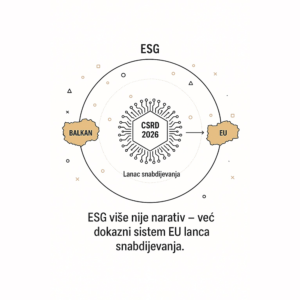
Companies in the Balkans often view EU regulatory requirements as something distant, complicated, and “reserved for big players in the EU.”
That perception is wrong.
With the entry into force of the CSRD directive (Corporate Sustainability Reporting Directive), ESG (Environmental, Social, Governance) ceases to be a voluntary practice and becomes a legal fact – even for companies that are not formally registered in the European Union.
This is not a new report.
This is a new system of business validation.
I. Who Is at Risk: Geography No Longer Protects You
CSRD formally applies to companies in the EU, but its real reach extends through the supply chain. This is exactly where the Balkans enter the regulatory picture.
Direct obligation (EU companies – from 2026)
Companies that meet two out of three criteria:
- more than 250 employees;
- more than EUR 40 million in revenue;
- more than EUR 20 million in total assets;
Must report in accordance with the CSRD standard.
Indirect obligation for the Balkans
If you are:
- a supplier to an EU company
- an IT or outsourcing partner
- part of the production, logistics or consulting chain, your EU partner will have to request from you ESG data that is verifiable and auditable.
Failure to provide this data means:
Neuspjeh u dostavljanju tih podataka znači:
- loss of contracts;
- exclusion from the supply chain;
- reputational damage that is difficult to repair.
Greenwashing as a new legal risk
Improvised ESG data is no longer a “marketing problem”.
It becomes:
- a legal risk;
- a reputational threat;
- a potential basis for lawsuits and sanctions
II. The real problem: lack of visual auditability
Most companies misdiagnose the issue.
The problem is not:
- too much regulation;
- too many requirements;
- too many metrics.
The problem is poor system design for collecting and proving data.
CSRD requires:
- comparability;
- traceability;
- proof of origin for every data point.
Traditional ESG reports, based on dozens or hundreds of pages of text, create two key vulnerabilities:
Operational vulnerability
- data comes from different sectors;
- there are no standardized inputs;
- the process is slow, expensive, and error-prone.
Legal vulnerability
Regulators, banks, and investors do not want a narrative.
They want evidence that can be verified quickly.
Text can hide a problem.
Visual, structured evidence cannot.
III. The LDT solution: ESG as a protocol, not a document
Legal Design Thinking (LDT) fundamentally changes the ESG approach.
It does not add another report—it redesigns the system.
Visual ESG dashboard
A centralized view of:
- all mandatory CSRD metrics;
- the source of each data point;
- a clear audit trail.
Result: less confusion, more control.
Layered reporting (Layered Transparency)
Instead of one massive document:
- a short, visual ESG summary for the public and investors;
- complete technical documentation available to auditors and regulators.
Transparency without overload.
ESG supply chain protocol
Standardized, visual ESG checklists for suppliers:
- consistent data;
- lower risk of errors;
- CSRD compliance across the entire chain.
This is not administration.
This is legal infrastructure.
Companies in the Balkans that face CSRD:
- with improvised ESG reports;
- without changing how data is collected;
- without visual auditability
Will be the first to drop out of the EU value chain.
LDT does not simplify the law—it makes it provable.
Transparency becomes a competitive advantage, not a cost.
The question is not whether you have an ESG story.
The question is whether it is auditable.
Other blogs


CSRD: When ESG becomes a personal risk. How Evidence Architecture Moves ESG from Sustainability to Responsibility
March was traditionally reserved for closing the financial books. But from 2026...
Who will sign? CSRD and the end of collective responsibility in regional companies
March in the Balkans is traditionally a month of final accounts. But in 2026, March brings…