U.S. Supreme Court vs. the Executive Branch: what Balkan exporters need to know
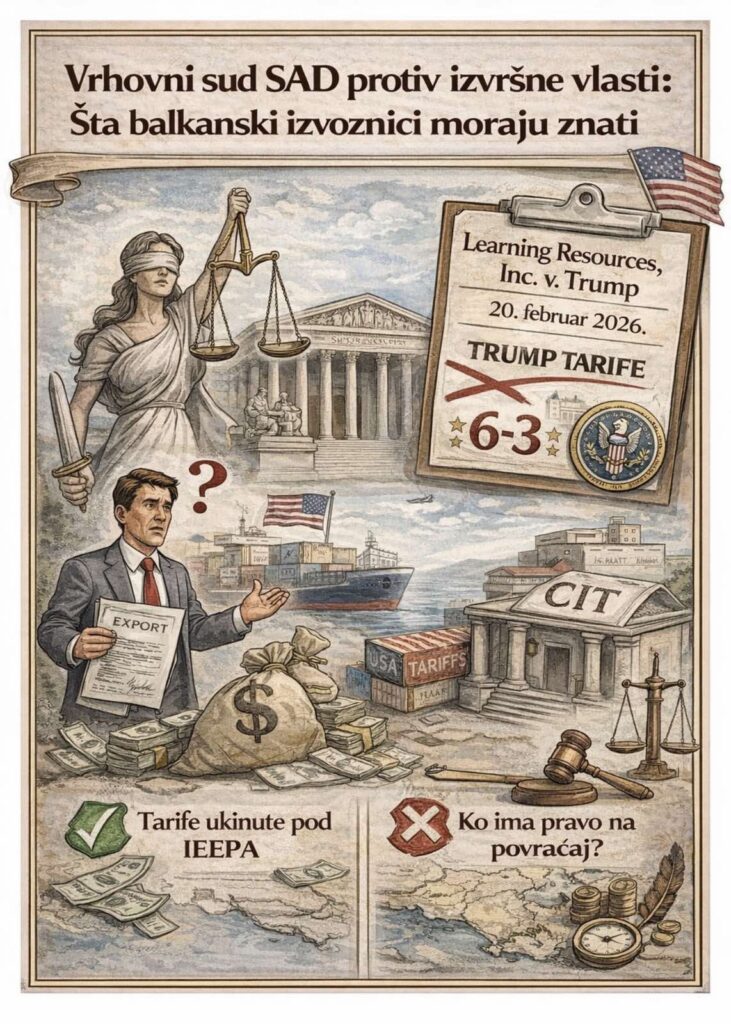
Analysis of the decision Learning Resources, Inc. v. Trump and its operational consequences
What happened?
On February 20, 2026, the Supreme Court of the United States issued its decision in the case Learning Resources, Inc. v. Trump, invalidating the tariff regime that the presidential administration had introduced under the International Emergency Economic Powers Act (IEEPA). In a 6–3 ruling, the Court held that tariffs are not a regulatory instrument—they are a form of taxation. The power of taxation under the U.S. Constitution belongs to Congress, not the executive branch, and cannot be derived from a general statutory authorization to manage emergencies.
This is not a narrow trade decision. It is a constitutional ruling on the limits of executive power in the economic sphere.
The Court applied the Major Questions Doctrine: where executive action carries economic and political significance of vast scale—here, a tariff regime generating between $160 and $175 billion in revenue—clear and explicit congressional authorization is required. General language in emergency legislation does not meet that threshold.
What followed?
On March 4, 2026, the U.S. Court of International Trade (CIT) ordered U.S. Customs and Border Protection (CBP) to initiate the process of refunding unlawfully collected duties. CBP is developing an electronic refund system called CAPE within its Automated Commercial Environment (ACE), with an interim deadline of April 20, 2026.
The administration did not withdraw. It immediately introduced new tariffs—this time under Section 122 of the Trade Expansion Act of 1962, which constitutes clear congressional authorization. The tariff pressure therefore remains, only under a different legal basis.
The government has until May 4, 2026 to file an appeal against the CIT order. If the appeal succeeds, the right to refunds could be limited only to the parties that initiated legal proceedings.
Who is entitled to a refund—and why the answer is not simple?
This is the point where Balkan exporters most often make incorrect assumptions.
The right to file a claim in the CAPE system belongs exclusively to the importer of record in the United States—the U.S. legal entity that physically imported the goods into the country and paid the duty to CBP. That is your American buyer, distributor, or partner, not your company.
A Balkan exporter has no direct right to a refund, except in one scenario: if, by contract, it assumed the role of the party bearing the customs burden.
Here, the contractual structure is decisive.
Incoterms are standardized rules of the International Chamber of Commerce that determine who bears costs and risks in international sales. Two clauses are operationally relevant:
- DDP (Delivered Duty Paid) – the seller, i.e. your company, bears all costs including duties in the destination country. If you delivered under DDP in the period April 2025 – February 2026, you effectively bore the customs burden, either through pricing or directly.
- DAP (Delivered at Place) – the goods arrive at the agreed location, but the duty in the U.S. is paid by the buyer. The customs burden is on the American partner.
If your American partner operated under DAP, they bore the duty and now potentially have the right to a refund. This does not mean you were harmed in a legal sense. But it does mean that in negotiating new contractual terms, you possess a relevant fact about your partner’s economic position.
Three operational steps
Step 1: Review of contractual structure
Review all contracts concluded or active in the period April 2025 – February 2026. Determine which Incoterms were used and who was contractually responsible for customs costs. This is not an administrative step—it is the legal basis for everything that follows.
Step 2: Review of deadlines
For entries that have not yet been liquidated: it is possible to file a post-summary correction directly with CBP. For entries that have been liquidated and where liquidation is not final: it is possible to file a protest under 19 U.S.C. § 1514. These deadlines run regardless of whether your American partner is taking action. If you miss the deadline, the right expires.
Step 3: Contractual mechanism for the future
The Learning Resources decision does not guarantee stability of the tariff environment. The administration immediately applied an alternative legal basis for new tariffs. New contracts must include clauses that clearly allocate customs risk and provide a mechanism for adjustment in case of regulatory change—regardless of which party bears the burden in a specific transaction.
The broader picture
The Learning Resources decision has implications that go beyond trade law. The U.S. Supreme Court has set a standard: the executive branch cannot assume core legislative powers by invoking general emergency authorities, even in the field of foreign economic policy. That principle—that economic measures of vast scope require clear legislative authorization—also resonates in the European regulatory space, particularly in the context of delegated acts and the implementation of the AI Act.
For lawyers advising clients with export exposure to the U.S., this is the moment to review not only contractual clauses, but also the overall allocation of regulatory risk in existing and future arrangements.
Other blogs


US Supreme Court vs. Executive Branch: What Balkan Exporters Need to Know
Analysis of the decision Learning Resources, Inc. v. Trump and its operational consequences...
CSRD 2026: The Omnibus I Shift and the Standard of Due Diligence
Beyond compliance: Why evidence architecture is now a legal necessity – and a personal risk…