Global ESG Risk Escalation
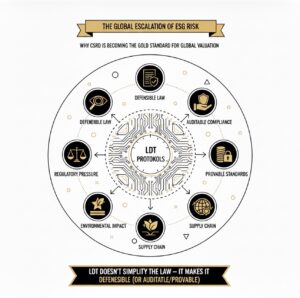
Why CSRD Becomes the Golden Standard for Global Valuation
Companies around the world still view ESG as a regulatory trend coming from Europe.
That perception is wrong.
With the implementation of the CSRD directive (Corporate Sustainability Reporting Directive), ESG ceases to be voluntary and becomes a globally measurable, legally binding system.
This is not a European problem. This is a global business validation model.
I. Who Is at Risk: Geography No Longer Protects
Although CSRD formally comes from the European Union, its impact is extraterritorial. Direct obligation (EU market – from 2026)
CSRD applies to:
- Large EU companies;
- Non-EU companies generating significant revenue in the EU;
If you operate in the EU market – CSRD applies to you.
2. Indirect obligation (global supply chain)
Multinational companies will require ESG data from:
- Suppliers in Asia;
- Manufacturers in Latin America;
- IT and service partners worldwide.
If your client must prove ESG compliance – you must provide proof.
Non-compliance means:
- loss of contracts;
- Exclusion from the supply chain;
- Global reputational risk.
3. Greenwashing as a Global Legal Risk
Unverifiable ESG claims are no longer just a marketing problem.
Regulators (SEC, FTC, EU Commission) actively sanction:
- Unprovable “green” claims;
- Non-auditable ESG reports.
Greenwashing becomes a universal legal risk.
II. The Real Problem: Lack of Visual Auditability
Most companies misdiagnose the ESG problem.
The problem is not:
- Too many standards;
- Too much data;
- Too much regulation.
The problem is a fragmented, invisible proof system.
Global ESG data comes from different jurisdictions, processes, and standards, creating three key vulnerabilities:
- Data is collected locally;
- No unified inputs;
- Manual processes introduce errors.
2. Legal vulnerability
Auditors require:
- Comparability;
- Traceability;
- Clear audit trail.
Textual reports cannot provide this.
3. Weak link: Supply chain
One non-compliant supplier can:
- Compromise the entire corporation;
- Jeopardize regulatory compliance;
- Trigger legal and reputational risk.
III. The LDT solution: ESG as a protocol, not a document
Legal Design Thinking (LDT) transforms ESG from narrative into a functional system. Visual ESG Dashboard
Centralized control panel that:
- Consolidates global ESG metrics;
- Shows the source of each data point;
- Allows instant auditing.
Result: global auditability.
2. Layered Transparency
Instead of one massive report:
- Visual ESG summary for investors;
- Full technical documentation for auditors.
Transparency without overload.
3. ESG Protocol for the Global Supply Chain
Visual LDT tools for suppliers:
- Standardized ESG checklists;
- Plain language questionnaires;
- Comparable source data.
This ensures:
- Closing greenwashing gaps;
- Reducing regulatory risk;
- Strengthening the entire chain.
Visualization Becomes the New Currency of Trust
In 2026, ESG is no longer a matter of intent, but of proof.
Companies unable to display their ESG performance:
- Visually;
- Clearly;
- Auditably
Will be:
- Discounted in valuation;
- Exposed to legal risk;
- Excluded from key value chains
LDT does not simplify the law. It makes it provable.
If your ESG data is not visual and auditable, can it even be legally sustainable?
Other blogs


CSRD: When ESG becomes a personal risk. How Evidence Architecture Moves ESG from Sustainability to Responsibility
March was traditionally reserved for closing the financial books. But from 2026...
Who will sign? CSRD and the end of collective responsibility in regional companies
March in the Balkans is traditionally a month of final accounts. But in 2026, March brings…