The Deepfake Era – Designing a Legal Protocol for Verifying the Authenticity of Corporate Communication
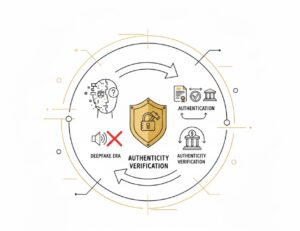
The emergence of generative AI has enabled mass production of Deepfake (AI-generated) audio and video content. For global companies, this is no longer just a PR problem but an existential financial and legal risk. A fake video of a CEO resigning or an invented audio clip about a defective product can trigger an immediate drop in stock price, regulatory investigations (SEC, financial authorities), and shareholder lawsuits.
Traditional crisis plans were not designed to combat forensically advanced disinformation. In a high-pressure situation, a company must not waste time on mere denial; it must present legally valid and technically supported proof that the content is fake.
Authenticity as the most valuable currency
Deepfake attacks create a unique set of risks that must be addressed:
- Financial Volatility: Publishing false information at a critical moment (e.g., before market close) causes immediate damage. The speed of the rebuttal is crucial.
- Legal Liability: Failure to quickly rebut disinformation can be interpreted as a failure in the Duty of Care owed to shareholders and the market.
- Loss of Trust: If the public cannot trust the CEO’s voice or the company’s official channels, the brand’s credibility is irreversibly damaged.
What must be designed is a Proof of Authenticity that is resistant to court and regulatory scrutiny.
LDT: Designing a Protocol for Rapid Forensic Defense
LDT transforms the chaos of crisis communication into a controlled, legally guided process.
- Visual Deepfake Response Map:
LDT creates a simple graphical flowchart for the crisis team. It visually displays two paths of action: IF the fake content is audio (Step 1: Voice Forensics), THEN the public statement is Step 2A. IF it is video (Step 1: Image Forensics), THEN Step 2B follows. This eliminates improvisation. - Forensic Audit Dashboard:
LDT designs a control panel for legal and security teams. When the Legal Tech tool (forensic platform) completes its analysis, the dashboard visually displays critical evidence: Red indicates a high likelihood that the content is AI-generated (synthetic traces), while Green indicates authenticity. This visual display serves as direct legal evidence for the rebuttal, allowing the team to immediately include technical data in the press release. - Authenticity Signature Protocol (Preventive Measure):
As a preventive measure, LDT is used to design a visual protocol for digitally signing (watermarking) all key corporate communication (CEO video messages, official documents). Legal teams receive a visual check indicating whether communication is original and protected.
LDT is critical because it enables companies in the Deepfake era to defend themselves with evidence, not just denial. By designing a forensically supported verification protocol, a company protects not only its reputation but also its financial stability and regulatory compliance obligations toward shareholders.
When a Deepfake strikes, will you rely on denial or on visual, legally indisputable proof?
Other blogs


CSRD: When ESG becomes a personal risk. How Evidence Architecture Moves ESG from Sustainability to Responsibility
March was traditionally reserved for closing the financial books. But from 2026...
Who will sign? CSRD and the end of collective responsibility in regional companies
March in the Balkans is traditionally a month of final accounts. But in 2026, March brings…