ECO-FRAUD (GREENWASHING) Risk in Co-Branding
When the GRS Certificate and Braille Packaging Become a Legal Problem
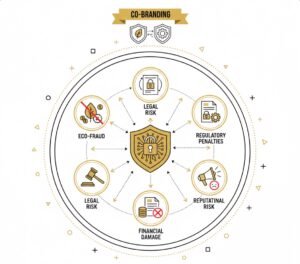
The sustainable electronics industry is standing at the intersection of economic value and legal risk. Companies that highlight Circular Design practices and ethical initiatives attract co-branding partners and investors. However, every green claim becomes a potential target for greenwashing lawsuits if it is not backed by indisputable legal documentation.
The risk increases within co-branding partnerships. If your partner company is exposed to a greenwashing lawsuit, your reputation and brand become automatically endangered.
GRS Certificate: The Legal Weak Point of the Supply Chain
GRS (Global Recycled Standard) is crucial, but not sufficient.
- Documentation Risk: The GRS certificate confirms that recycled material is used, but greenwashing lawsuits do not focus only on the certificate. They target transparency across the entire supply chain. If a company cannot visually and clearly present how the plastic is collected, how it enters production, and how supplier obligations are tracked (for example, energy use), the legal burden of proof falls on the company.
- Co-branding Problem: In a co-branding campaign, both parties share responsibility. If a partner (e.g., a corporation buying welcome packs) communicates or exaggerates your GRS claims incorrectly, you are exposed to risk because you did not design a control protocol for their communication.
Braille Packaging: Social Responsibility Risk (the S in ESG)
Inclusive design, such as Braille packaging, is an excellent signal of the Social component in ESG reporting. However, this must be supported by ethical and legal integrity.
- Grounds for Accusation: Prosecutors are not searching only for ecological deception. They look for proof that a claim is misleading or unverifiable. If initiatives such as Braille packaging are promoted as a key ethical advantage while the company simultaneously neglects other critical aspects (e.g., ethical hiring or safety in the supply chain), it becomes exposed to accusations of "Social Washing" or selective representation. People value honesty more than perfection.
- Need for Auditability: In the era of EU regulations (e.g., upcoming CSRD requirements), every ethical claim must be auditable. Braille packaging must be part of a broader, provable inclusion protocol.
LDT: Designing the Legal Eco-Passport of a Product
Legal Design Thinking (LDT) solves this challenge by turning certificates and ethical claims into Visual Legal Evidence (Audit Trail).
Solution 1: Visual Validation Protocol: LDT is used to design an internal risk map that visually shows legal and marketing teams which GRS claims are legally safe and which require additional documentation.
Solution 2: Digital Eco-Passport: LDT designs a simple graphical interface for the end user or partner. Instead of reading a long GRS document, the visual passport clearly displays:
1. The certified percentage of recycled content (GRS)
2. The specific legal clause that guarantees the co-branding partner will not exaggerate claims.
LDT enables companies to turn risks such as the GRS certificate and Braille packaging into their strongest defense. In the sustainable electronics industry, your defense is no longer the certificate itself, but the ability to visually, transparently, and legally prove every step of your green story. Without this, every co-branding agreement becomes a silent declaration of greenwashing risk.
Other blogs


CSRD: When ESG becomes a personal risk. How Evidence Architecture Moves ESG from Sustainability to Responsibility
March was traditionally reserved for closing the financial books. But from 2026...
Who will sign? CSRD and the end of collective responsibility in regional companies
March in the Balkans is traditionally a month of final accounts. But in 2026, March brings…