Category: Regional

  • CSRD 2026 BLUEPRINT — From ESG Reporting to Proof Architecture

    CSRD 2026 BLUEPRINT — From ESG Reporting to Proof Architecture

    Why a checklist is no longer enough.

    Most companies are entering 2026 with a task list. The problem is that a checklist only shows where you are vulnerable, but it does not tell you what you need to build in order to close those gaps.

    CSRD (Corporate Sustainability Reporting Directive) does not ask you for a better essay or a prettier annual report. CSRD requires a provable system. The difference between “we have data” and “we have a provable system” is the difference between passing and failing an audit.

    That is why today we are not talking about a document. We are talking about a Blueprint.

    I. What CSRD actually requires (and why many misunderstand it)

    CSRD is often, and incorrectly, perceived as just another set of ESG templates. In reality, the regulator is not asking for a narrative, but for systemic attributes:

    • Auditability: Can an external auditor trace every single number?
    • Traceability: Where was the data before it entered the table?
    • Comparability: Are your data points consistent with industry standards?
    • Proven accountability: Who, by name and surname, guarantees the integrity of the information?

    These are not textual requirements. These are architectural requirements.

    II. Why ESG reports fail in audit

    When audit firms (including “Big Four” firms) refuse to issue a positive opinion on an ESG report, the reason rarely lies in the numbers themselves. The problem is in the “background”:

    • Data without pedigree: The data “arrived by email” without a clear source.
    • ESG “stories” without an audit trail: The sustainability narrative has no digital signature to support it.
    • Supply chain “black holes”: Supplier data is collected ad-hoc, without quality control. The problem is not the content. The problem is the architecture that generates that content.

    III. CSRD Blueprint: ESG as a system, not a file

    For ESG to be defensible, it must be structured across five layers of provability:

    • Data Origin Layer: The exact point of data creation (sensor, invoice, HRM system) and a clearly defined responsible person.
    • Verification Layer: The protocol by which that data is verified before it enters the system.
    • Traceability Layer: A digital trail that enables tracking changes to the data over time.
    • Governance Layer: A clear structure of who signs, who approves, and who bears legal responsibility for accuracy.
    • Disclosure Layer: The final output adapted for investors and regulators (XBRL formatting).

    Without these layers, your ESG report is only a collection of claims that nobody can confirm.

    IV. Why the supply chain is the critical breaking point

    CSRD does not end at your company’s doors. It breaks at your suppliers.

    A single key supplier without clear inputs and an audit trail is enough to compromise your entire system.

    The Blueprint therefore must not be closed inside your IT environment — it must define communication standards with external partners.

    V. The Blueprint is not implementation — but without it, implementation makes no sense

    It is important to understand: the Blueprint does not replace your lawyers, auditors, or IT providers. It is the master plan that gives them direction.

    Without a Blueprint:

    • Implementation becomes chaotic: Every department works in its own way.
    • Costs increase: You purchase software that cannot communicate with each other.
    • Risk remains invisible: You will discover the system does not work only when the auditor asks the first question.

    CSRD compliance is not a question of reporting at the end of the year. It is a question of designing a provability system that operates 365 days a year.

    If you cannot prove ESG — you cannot defend it.

    Download ESG Proof Architecture 2026 Balkan Edition
    CSRD / ESG CHECKLIST – BALKAN EDITION 2026 (Montenegrin) CSRD 2026 BLUEPRINT: ESG Proof Architecture (Montenegrin)

    Other blogs

  • CSRD 2026: Why the Balkans Are Losing Contracts Before Realizing It’s Mandatory

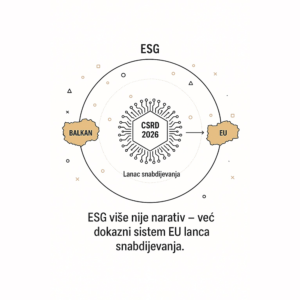
    CSRD 2026: Why the Balkans Are Losing Contracts Before Realizing It’s Mandatory. ESG Is No Longer a Report – It’s a Trust Filter in the EU Supply Chain

    Companies in the Balkans often view EU regulatory requirements as something distant, complicated, and “reserved for big players in the EU.”

    That perception is wrong.

    With the entry into force of the CSRD directive (Corporate Sustainability Reporting Directive), ESG (Environmental, Social, Governance) ceases to be a voluntary practice and becomes a legal fact – even for companies that are not formally registered in the European Union.

    This is not a new report.

    This is a new system of business validation.

    I. Who Is at Risk: Geography No Longer Protects You

    CSRD formally applies to companies in the EU, but its real reach extends through the supply chain. This is exactly where the Balkans enter the regulatory picture.

    Direct obligation (EU companies – from 2026)

    Companies that meet two out of three criteria:

    • more than 250 employees;
    • more than EUR 40 million in revenue;
    • more than EUR 20 million in total assets;

    Must report in accordance with the CSRD standard.

    Indirect obligation for the Balkans

    If you are:

    • a supplier to an EU company
    • an IT or outsourcing partner
    • part of the production, logistics or consulting chain, your EU partner will have to request from you ESG data that is verifiable and auditable.

    Failure to provide this data means:

    Neuspjeh u dostavljanju tih podataka znači:

    • loss of contracts;
    • exclusion from the supply chain;
    • reputational damage that is difficult to repair.

    Greenwashing as a new legal risk

    Improvised ESG data is no longer a “marketing problem”.

    It becomes:

    • a legal risk;
    • a reputational threat;
    • a potential basis for lawsuits and sanctions

    II. The real problem: lack of visual auditability

    Most companies misdiagnose the issue.

    The problem is not:

    • too much regulation;
    • too many requirements;
    • too many metrics.

    The problem is poor system design for collecting and proving data.

    CSRD requires:

    • comparability;
    • traceability;
    • proof of origin for every data point.

    Traditional ESG reports, based on dozens or hundreds of pages of text, create two key vulnerabilities:

    Operational vulnerability

    • data comes from different sectors;
    • there are no standardized inputs;
    • the process is slow, expensive, and error-prone.

    Legal vulnerability
    Regulators, banks, and investors do not want a narrative.
    They want evidence that can be verified quickly.
    Text can hide a problem.
    Visual, structured evidence cannot.

    III. The LDT solution: ESG as a protocol, not a document

    Legal Design Thinking (LDT) fundamentally changes the ESG approach.

    It does not add another report—it redesigns the system.

    Visual ESG dashboard

    A centralized view of:

    • all mandatory CSRD metrics;
    • the source of each data point;
    • a clear audit trail.

    Result: less confusion, more control.

    Layered reporting (Layered Transparency)
    Instead of one massive document:

    • a short, visual ESG summary for the public and investors;
    • complete technical documentation available to auditors and regulators.

    Transparency without overload.

    ESG supply chain protocol
    Standardized, visual ESG checklists for suppliers:

    • consistent data;
    • lower risk of errors;
    • CSRD compliance across the entire chain.

    This is not administration.
    This is legal infrastructure.

    Companies in the Balkans that face CSRD:

    • with improvised ESG reports;
    • without changing how data is collected;
    • without visual auditability

    Will be the first to drop out of the EU value chain.

    LDT does not simplify the law—it makes it provable.
    Transparency becomes a competitive advantage, not a cost.
    The question is not whether you have an ESG story.
    The question is whether it is auditable.

    Download CSRD / ESG CHECKLIST – BALKAN EDITION 2026 [In Montenegrin]

    Other blogs

  • Greenwashing in Consumer Protection Law: Three Key Risks for Companies in the Region

    Greenwashing in Consumer Protection Law: Three Key Risks for Companies in the Region

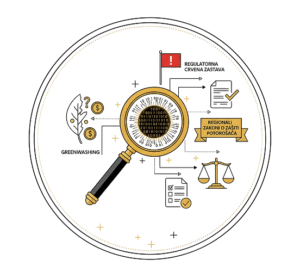
    When “Green” Becomes a Regulatory Red Flag

    The pressure from consumers and investors for companies to act sustainably has never been greater. As a result, environmental claims have flooded the market—from “eco-friendly packaging” to “carbon-neutral” services. However, when these claims are not substantiated, we enter the zone of Greenwashing—and that’s where the Law steps in.
    In countries across the region, the Consumer Protection Act (CPA) is the main legal instrument used to sanction such practices, treating them as misleading business conduct. Greenwashing, therefore, is not just an ethical failure—it’s a direct violation of the law.

    What are the three most significant risks companies in the region face under the scrutiny of the CPA?

    The Consumer Protection Act in the region (Serbia, Croatia, Bosnia and Herzegovina, Montenegro, etc.) clearly prohibits unfair business practices, particularly those that are misleading.
    A business practice is considered misleading when a trader induces a consumer to make a purchasing decision they otherwise wouldn’t have made—by providing false or unverifiable information. This is the very definition of Greenwashing.
    A company doesn’t have to lie; it’s enough to withhold essential information or use vague, generic terms without precise scientific backing.

    Three Key Risks for Companies in the Region

    • Direct Financial Penalties
      This is the most obvious and immediate risk. The Market Inspectorate, as the main authority for enforcing the CPA, is authorized to initiate misdemeanor proceedings against companies engaged in misleading advertising.
      Penalty Amounts: The laws impose significant fines, often ranging from several thousand to tens of thousands of euros (depending on the specific country’s legislation and company size). In some cases, penalties are calculated as a percentage of annual turnover (as in the EU), making them especially painful for large corporations.
      Procedure: Sanctions are imposed once it’s determined that a claim (e.g., “100% natural” or “climate neutral”) isn’t backed by evidence (such as tests, certificates, or LCA analyses).
      Example: A company claims its product is “fully recyclable,” but ignores the fact that local recycling infrastructure cannot process that type of packaging—this constitutes a misleading claim punishable under the CPA.
    • Reputational Collapse and Loss of Consumer Trust
      Although not directly regulated by the CPA, reputational risk often has far-reaching and costlier consequences than the financial penalty itself. In the age of social media, news about a Greenwashing fine spreads rapidly.
      “Cancel Culture”: Consumers—especially younger generations—are extremely sensitive to unethical business behavior. Public backlash and boycott campaigns can cost a company millions through reduced sales and long-term brand damage.
      Impact on B2B and Investors: A reputation problem with consumers quickly extends to business partners (B2B) and investors. Loss of trust can make it harder to raise capital and may decrease share value.
    • Regulatory Measures and Mandatory Correction
      In addition to fines, a company is legally required under the Consumer Protection Act to immediately remove the misleading advertisement and, in some cases, publish a correction at its own expense.
      Correction Costs: This includes expenses for withdrawing disputed marketing materials, redesigning packaging, and—in extreme cases—recalling products from the market. This creates significant operational pressure and additional financial burdens.
      Increased Oversight: Once fined, a company becomes the target of increased scrutiny by inspection authorities. Every new environmental claim will be carefully analyzed and verified, slowing down the launch of new products and marketing campaigns.

    How to Avoid the Greenwashing Trap

    The only way to avoid these risks is by adopting the principle of provable transparency.
    Instead of relying on expensive legal battles after inspections, the focus should be on preventive measures:

    Scientific Substantiation: Every claim must be supported by internal or external technical documentation (e.g., Life-Cycle Assessment or independent certification).
    Precision: Forget vague terms like “eco-friendly.” Use precise language: “The packaging contains 30% recycled plastic” or “We reduced CO2 emissions by 15% over the past two years in production process X.”

    Legal Design Thinking (LDT): Use the LDT methodology to transform complex technical evidence into visually clear and legally defensible marketing materials—understandable to both consumers and regulators.

    Transparency as the Only Defense
    Under regional Consumer Protection Laws, Greenwashing is treated as a serious form of deception. The risks of high fines, catastrophic reputational damage, and operational paralysis are real.
    For companies in the region, the path to compliance lies in full transparency and the creation of marketing claims that are irrefutable. Otherwise, the cost of deception will always outweigh the cost of truth.

    Other blogs

ENG