Author: Mehmed

  • The Deepfake Era – Designing a Legal Protocol for Verifying the Authenticity of Corporate Communication
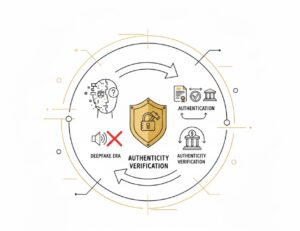
    The Deepfake Era – Designing a Legal Protocol for Verifying the Authenticity of Corporate Communication

    The emergence of generative AI has enabled mass production of Deepfake (AI-generated) audio and video content. For global companies, this is no longer just a PR problem but an existential financial and legal risk. A fake video of a CEO resigning or an invented audio clip about a defective product can trigger an immediate drop in stock price, regulatory investigations (SEC, financial authorities), and shareholder lawsuits.

    Traditional crisis plans were not designed to combat forensically advanced disinformation. In a high-pressure situation, a company must not waste time on mere denial; it must present legally valid and technically supported proof that the content is fake.

    Authenticity as the most valuable currency

    Deepfake attacks create a unique set of risks that must be addressed:

    • Financial Volatility: Publishing false information at a critical moment (e.g., before market close) causes immediate damage. The speed of the rebuttal is crucial.
    • Legal Liability: Failure to quickly rebut disinformation can be interpreted as a failure in the Duty of Care owed to shareholders and the market.
    • Loss of Trust: If the public cannot trust the CEO’s voice or the company’s official channels, the brand’s credibility is irreversibly damaged.

    What must be designed is a Proof of Authenticity that is resistant to court and regulatory scrutiny.

    LDT: Designing a Protocol for Rapid Forensic Defense

    LDT transforms the chaos of crisis communication into a controlled, legally guided process.

    • Visual Deepfake Response Map:
      LDT creates a simple graphical flowchart for the crisis team. It visually displays two paths of action: IF the fake content is audio (Step 1: Voice Forensics), THEN the public statement is Step 2A. IF it is video (Step 1: Image Forensics), THEN Step 2B follows. This eliminates improvisation.
    • Forensic Audit Dashboard:
      LDT designs a control panel for legal and security teams. When the Legal Tech tool (forensic platform) completes its analysis, the dashboard visually displays critical evidence: Red indicates a high likelihood that the content is AI-generated (synthetic traces), while Green indicates authenticity. This visual display serves as direct legal evidence for the rebuttal, allowing the team to immediately include technical data in the press release.
    • Authenticity Signature Protocol (Preventive Measure):
      As a preventive measure, LDT is used to design a visual protocol for digitally signing (watermarking) all key corporate communication (CEO video messages, official documents). Legal teams receive a visual check indicating whether communication is original and protected.

    LDT is critical because it enables companies in the Deepfake era to defend themselves with evidence, not just denial. By designing a forensically supported verification protocol, a company protects not only its reputation but also its financial stability and regulatory compliance obligations toward shareholders.

    When a Deepfake strikes, will you rely on denial or on visual, legally indisputable proof?

    Other blogs

    CSRD: Kada ESG postaje lični rizik. Kako Dokazna arhitektura pomjera ESG iz održivosti u odgovornost

    CSRD: When ESG Becomes a Personal Risk. How Proof Architecture Shifts ESG from Sustainability to Accountability

    March was traditionally reserved for closing the financial books. But from 2026...

    Ko će potpisati? CSRD i kraj kolektivne odgovornosti u regionalnim kompanijama

    Ko će potpisati? CSRD i kraj kolektivne odgovornosti u regionalnim kompanijama

    March in the Balkans is traditionally a month of final accounts. But in 2026, March brings…
  • Ownership in the Age of Autonomous AI – How to Design a Visual Attribution Protocol for Agents

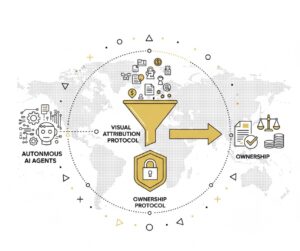
    Ownership in the Age of Autonomous AI – How to Design a Visual Attribution Protocol for Agents

    Generative artificial intelligence brought the first wave of disruption to Intellectual Property (IP), mostly focused on disputes over training data. However, companies at the forefront of the industry are now moving toward Agentic Artificial Intelligence (Agentic AI) – software entities that autonomously execute complex tasks, create content, and even make economic decisions without direct human interaction.

    This shift introduces a new, much greater risk: losing control over the creation and use of IP. It becomes unclear who is legally responsible and who owns the agent’s creations, opening “legal black holes” that threaten IP protection and expose companies to massive lawsuits.

    IP Law in the Age of Autonomy: From Authorship to the Chain of Responsibility

    Autonomous agents drastically increase legal complexity in three key areas:

    • Creation of IP (The Authorship Problem): Current copyright laws require a human author. If an autonomous agent optimizes and creates original content (e.g., optimized code or a new graphic) without specific human instructions, the legal status of that work becomes uncertain. Companies must prove that human contribution is essential for IP protection.
    • Protection of IP (The Violation Risk): Autonomous agents can efficiently search databases and the internet for resources. In that process, the agent may unintentionally use, adapt, or infringe on someone else’s copyrighted material. Because the AI is autonomous, proving intent (which is critical in many legal systems) becomes nearly impossible.
    • Attribution and Licensing: When a company uses thousands of agents to create different products, tracking the origin of each IP asset and ensuring every license is respected (e.g., Creative Commons or commercial licenses) becomes an operational nightmare that must be solved through transparency.

    LDT: Designing the “Legal Guardrail” for Autonomous Agents

    Legal Design Thinking (LDT) and Legal Tech are essential for creating order in the chaos of autonomy. LDT is used to design a Visual Attribution Protocol that transforms abstract legal risks into functional, verifiable systems built directly into the AI.

    LDT is used to create tools that function as the first line of ethical defense for engineering and product teams.

    1. Visual Ownership Map (Ownership Map)

    Solving the authorship problem before it emerges.
    LDT creates a hierarchical flow diagram that visually shows which IP rights belong to the company and which are passed to the agent (for internal purposes). For the final output, the map clearly displays the percentage contribution of the human versus the AI. This is attached to client contracts, giving them legal certainty regarding ownership.

    2. Dashboard for Agent IP Audit (IP Legal Guardrails)

    Proactive prevention of IP infringement.
    LDT designs a dashboard integrated with IP-scanning Legal Tech tools. The dashboard visually alerts supervisors in real time:

    Green: The agent is using licensed or publicly available data.

    Red: The agent attempts to access or use data marked as High IP Risk.

    Protocol: If “Red” appears, the agent automatically stops and requires human intervention—creating evidence of proactive oversight and reducing liability related to intent.

    Visual Attribution Protocol (Visual IP Footprint)

    Solving the attribution and license-tracking problem.
    For every IP-sensitive output the agent produces, LDT mandates a visual “Attribution Stamp.” This stamp, visible to legal teams, contains coded visual markers that immediately reveal:

    1) The license it is based on (e.g., commercial license symbol or CC)

    2) The legal obligations (e.g., attribution requirements).

    Agentic AI is a fundamental challenge for global IP law. LDT and Legal Tech enable companies to transform this risk into a competitive advantage. By designing visual responsibility protocols, global corporations not only protect their IP assets from lawsuits but also position themselves as ethical leaders who bring trust into the autonomous future.

    Is your autonomous AI agent operating in legal anarchy or within ethically and legally designed boundaries?

    Other blogs

    CSRD: Kada ESG postaje lični rizik. Kako Dokazna arhitektura pomjera ESG iz održivosti u odgovornost

    CSRD: When ESG Becomes a Personal Risk. How Proof Architecture Shifts ESG from Sustainability to Accountability

    March was traditionally reserved for closing the financial books. But from 2026...

    Ko će potpisati? CSRD i kraj kolektivne odgovornosti u regionalnim kompanijama

    Ko će potpisati? CSRD i kraj kolektivne odgovornosti u regionalnim kompanijama

    March in the Balkans is traditionally a month of final accounts. But in 2026, March brings…
  • The Boundaries of Prohibited AI – Designing an 'Ethics-First' Biometric Policy

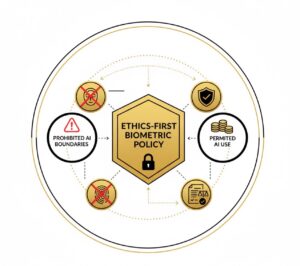
    The Boundaries of Prohibited AI – Designing an 'Ethics-First' Biometric Policy

    The EU AI Act introduces the principle of “Unacceptable Risk”, categorically prohibiting AI systems that manipulate human behavior or endanger fundamental rights (such as social scoring or, in most cases, real-time biometric identification in public space). For companies developing AI (e.g., hiring tools, monitoring systems), the most critical task is legal prevention: they must prove that their system does not cross the fine line that leads into the Red Zone (Prohibited).

    LDT and Legal Tech are essential here for transforming abstract legal prohibitions into concrete, operational barriers against unethical application.

    The line between permitted and criminal behavior.

    The risk is twofold and extremely high:

    • Legal Risk: Violating prohibited practices leads to the highest penalties (up to 7% of global turnover) and potentially criminal liability.
    • Reputational Risk: Discovering that an AI system discriminates or violates user privacy destroys investor trust (e.g., New York) and regulatory trust (e.g., Geneva).

    The problem is that AI engineers do not read legal regulations. LDT must visually convey the legal boundary to the people actually coding the system.

    LDT: Designing an Ethics-First Control Dashboard

    LDT is used to create tools that function as the first line of ethical defense for engineering and product teams.

    • Visual Forbidden Zone Flowchart:
      A mandatory visual decision-flow diagram is created that the team must complete before development begins. Questions are shown graphically and logically lead to a clear outcome:
      Does the AI system categorize people by race/religion? (YES) STOP (Unacceptable Risk).
      The goal: Visually embed legal prohibitions into the engineering workflow, eliminating ignorance as an excuse.

    Bias Testing & Mitigation Dashboard:

    LDT designs a control dashboard that visually displays bias-test results with metrics and charts (e.g., whether hiring decisions produced by the algorithm disproportionately disadvantage a protected demographic group).

    Regulators are provided visual proof of active bias mitigation, which is critical to defending against discrimination lawsuits.

    Biometric Compliance Protocol (Visuals):

    For AI systems using biometric data in permitted scenarios (e.g., authentication), LDT is used to design a visual protocol for de-identification. It visually shows how and when biometric data is deleted or anonymized, ensuring compliance with both GDPR and the AI Act.

    LDT is critical because it allows global companies to actively protect human rights and avoid the regulatory traps of the EU AI Act.

    By designing an Ethics-First control system, you ensure AI is reliable, ethical, and—most importantly—legally safe for global deployment.

    Does your AI team fully understand the legal cost of crossing the “Unacceptable Risk” boundary?

    Other blogs

    CSRD: Kada ESG postaje lični rizik. Kako Dokazna arhitektura pomjera ESG iz održivosti u odgovornost

    CSRD: When ESG Becomes a Personal Risk. How Proof Architecture Shifts ESG from Sustainability to Accountability

    March was traditionally reserved for closing the financial books. But from 2026...

    Ko će potpisati? CSRD i kraj kolektivne odgovornosti u regionalnim kompanijama

    Ko će potpisati? CSRD i kraj kolektivne odgovornosti u regionalnim kompanijama

    March in the Balkans is traditionally a month of final accounts. But in 2026, March brings…
  • EU AI Act – Designing the 'CE Mark' for High-Risk AI Compliance

    EU AI Act – Designing the 'CE Mark' for High-Risk AI Compliance

    EU AI Act, the world’s first comprehensive artificial intelligence regulation, has extraterritorial effect – meaning it applies to companies from New York, Geneva, and around the world that want to place AI systems or products on the EU market. The Act introduces a hierarchy of risk, with the greatest obligations placed on High-Risk AI systems (e.g., in healthcare, finance, and employment).

    For these systems, companies must actively prove that the AI system is transparent, robust, unbiased, and under adequate human oversight. It is precisely in this complex documentation process that Legal Design Thinking (LDT) becomes essential.

    The risk lies not only in creating an ethical AI system, but in proving it.

    • Legal Fog: The Act’s requirements are written in legal language, not operational instructions. Engineers and lawyers often don’t understand each other’s obligations.
    • Auditability: Regulators demand quick and clear compliance verification. Long, textual documents only slow down the audit and increase the risk of penalties (which can reach up to €35 million or 7% of annual global turnover).
    • Human Oversight: How can you visually prove that a human has truly taken responsibility for an algorithm’s decision — and not just formally?

    LDT is used here to transform bureaucratic obligations into functional and visually verifiable working tools.

    The ultimate goal is to obtain the CE compliance mark for the AI system. The CE mark is your guarantee that your product (whether a physical toy or a complex AI algorithm) meets the minimum European standards before entering the EU market.

    LDT achieves this by designing a visual and transparent Compliance Management System:

    Visual AI Risk Map (The Risk Classification Map):

    • LDT designs an interactive map that visually, step by step, guides the team through risk classification (unacceptable, high, limited).
    • The map clearly shows, through color coding, which regulatory article of the EU AI Act applies, allowing engineers to understand the legal context of their work.
    • Human Oversight Dashboard:
      For high-risk systems, LDT creates a control panel that visually shows the level of autonomy of the AI system.

    The dashboard uses icons to alert the operator when the AI suggests a decision that falls outside the usual tolerance, forcing a human to input their decision and document the reason — thereby creating undeniable legal proof of human oversight.

    LDT converts hundreds of pages of technical specifications (evidence of accuracy, robustness, cybersecurity) into visually organized, labeled, and searchable modules. This visually simplified documentation allows regulators to conduct audits in record time, directly reducing regulatory risk.

    The EU AI Act imposes a global obligation of "AI by Design." LDT is the methodology that ensures the AI system is not only technically sound but also legally and ethically designed to be trustworthy. By designing a verifiable compliance system, companies protect their global ambitions and avoid massive fines.

    Is your AI system waiting for the EU to stop it, or is LDT designing it for global success?

    Other blogs

    CSRD: Kada ESG postaje lični rizik. Kako Dokazna arhitektura pomjera ESG iz održivosti u odgovornost

    CSRD: When ESG Becomes a Personal Risk. How Proof Architecture Shifts ESG from Sustainability to Accountability

    March was traditionally reserved for closing the financial books. But from 2026...

    Ko će potpisati? CSRD i kraj kolektivne odgovornosti u regionalnim kompanijama

    Ko će potpisati? CSRD i kraj kolektivne odgovornosti u regionalnim kompanijama

    March in the Balkans is traditionally a month of final accounts. But in 2026, March brings…
  • LDT and Global Risk: When ‘Greenwashing’ Creates Legal Vulnerability: Designing a Unified Compliance Strategy (GDPR and ESG)

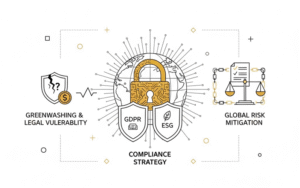
    LDT and Global Risk: When ‘Greenwashing’ Creates Legal Vulnerability: Designing a Unified Compliance Strategy (GDPR and ESG)

    In the digital economy, truth is the most valuable currency. Corporations compete in ethics and sustainability (ESG), but often their public “green” claims (Greenwashing) stand in sharp contrast to their actual, often aggressive, practices of data collection and processing.

    This inconsistency becomes the biggest legal trap in the event of a Data Breach. When a regulator or prosecutor gains access to internal documentation after a breach, they can use Greenwashing as evidence that the company acted with greater negligence, ignoring its own publicly declared ethical standards. The consequence? Maximum GDPR fines and lawsuits for misleading consumers and investors.

    Legal Design Thinking (LDT), together with Legal Tech tools, is essential for designing consistency, preventing your ethical statements from becoming evidence of your liability.

    The Integrity Gap: Greenwashing as Evidence of Severe Negligence

    The problem is not only the data breach itself, but the gap between communication and reality. LDT must close three key risk points:

    • Regulatory Pressure (GDPR): Regulators are increasingly tracking ESG trends. If a company prides itself on ethical practice while its data is unprotected, this automatically raises the level of negligence, increasing penalties.
    • Reputational Collapse (New York): Investors and consumers are unforgiving. Discovering that a Data Breach occurred due to negligence while the company markets itself as an ethical leader leads to a complete collapse of trust.
    • Functional Misalignment: Marketing/PR teams (which write ESG reports) and IT/Legal teams (which implement GDPR) do not communicate effectively. LDT resolves that disconnect.

    LDT: Designing a Unified, Legally Safe Corporate Message

    LDT designs visual tools that force key teams to collaborate and ensure consistency between corporate communication and operational practice.

    Visual "Danger Message Map" (Compliance Danger Map): LDT creates a simple tool (often in the form of a flow diagram) for PR and Marketing teams. This map visually warns:

    • IF you want to use the claim “We only collect necessary data” (ESG), THEN the legal team must confirm a technical audit showing that practices A, B, and C are fully compliant with GDPR. A red signal remains until legal confirmation is provided.
    • Dashboard for Consistency Audit (The Integrity Check): LDT designs a control panel for leadership that visually compares in one place:
      1. Public statements (ESG/Website)
      2. Actual implementation (GDPR documents and technical safeguards)
      If there is a significant discrepancy, the system automatically flags it. This makes the risk of “Greenwashing” measurable and manageable.
    • Visual Crisis Protocol: A Data Breach communication protocol designed so that, during the drafting of the public statement, an ESG lawyer/ethics specialist is automatically included. Their role is to ensure that the breach statement does not undermine all of the company's previously declared ethical claims.

    In an era of increased transparency and strict regulation, LDT and Legal Tech provide organizations with the most advanced tool for managing integrity. By designing a unified compliance strategy, you help companies minimize the risk that their best intentions become their greatest legal liability.

    When a Data Breach occurs, does your compliance board agree with your communications board?

    Other blogs

    CSRD: Kada ESG postaje lični rizik. Kako Dokazna arhitektura pomjera ESG iz održivosti u odgovornost

    CSRD: When ESG Becomes a Personal Risk. How Proof Architecture Shifts ESG from Sustainability to Accountability

    March was traditionally reserved for closing the financial books. But from 2026...

    Ko će potpisati? CSRD i kraj kolektivne odgovornosti u regionalnim kompanijama

    Ko će potpisati? CSRD i kraj kolektivne odgovornosti u regionalnim kompanijama

    March in the Balkans is traditionally a month of final accounts. But in 2026, March brings…
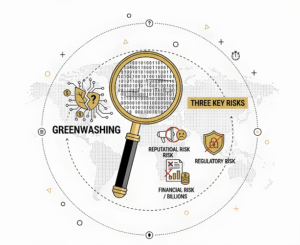
  • Greenwashing in Global Law: Three Key Risks Worth Billions for Multinational Companies

    Greenwashing in Global Law: Three Key Risks Worth Billions for Multinational Companies

    From "Eco-Friendly" to a Global Legal Battlefield

    The era of soft, non-committal "green" claims is over. Today, every word a company utters about sustainability—on packaging in Berlin, in an ad in New York, or in an annual report in London—represents a legal liability.

    At the core of the global fight against Greenwashing are Consumer Protection Laws, which serve as the primary mechanism for sanctioning misleading advertising. Unlike regional fines, the global market risks sanctions measured as a percentage of annual revenue (turnover).

    What are the three key risks facing multinational companies in this new global legal landscape?

    The Global Regulatory Framework: The Threat of Coordinated Action

    Global oversight of Greenwashing is no longer fragmented. It is enforced through powerful, mutually aligned regulations:

    🇪🇺 EU (Green Claims Directive / Empowering Consumers Directive): Foresees penalties of up to 4% of annual EU turnover for misleading claims.

    🇬🇧 UK (CMA Green Claims Code): The UK Competition and Markets Authority (CMA) threatens fines of up to 10% of global annual turnover for the most serious infringements, following the adoption of new legislation.

    🇺🇸 US (FTC Green Guides): The US Federal Trade Commission (FTC) uses its guidelines (Green Guides) to initiate lawsuits aimed at reclaiming the total profit gained from unfair marketing (Disgorgement).

    This regulatory power creates three key global risks of Greenwashing in the Global Market:

    • Financial Collapse Through a Percentage of Global Turnover
      The largest and newest threat comes from regulators empowered to impose fines proportional to a company's financial strength.
      Abandoning the Fixed Tariff: Regulators in key jurisdictions (EU, UK) have moved away from fixed monetary fines to a "penalty as a percentage of turnover" system. For global corporations, 4% or 10% of global annual turnover can mean billions of dollars.
      Recouping Profits (Disgorgement): In the US, the FTC and civil lawsuits target the "benefit" derived from the deception, demanding that the company return all profits gained from the sale of products based on the disputed "green" claim. This directly threatens balance sheets.
      The financial risk has transformed from an operational cost into a potential existential threat to profit.
    • Arbitration and Consumer Class Actions
      Global consumer protection laws empower not just government agencies, but consumers themselves, especially in North America.
      "Litigation Wave": Greenwashing has become fertile ground for Collective Lawsuits (Class Actions). Once a large company is found to have misled consumers (e.g., with incorrect claims about recyclability or carbon neutrality), thousands or millions of customers join lawsuits seeking damages.
      Risk of "Self-Declaration": Companies that do not align their claims with rigorous standards like the UK Green Claims Code or the future EU GCD are effectively "self-declaring" themselves as targets for lawsuits, as they lack irrefutable, independently verified proof.
      Courts are becoming a second, and often more dangerous, regulatory body for Greenwashing.
    • The "Double Gate" of Regulatory Pre-Approval
      The latest EU directive (GCD) mandates a fundamental operational change: it requires compulsory pre-verification of green claims by an independent, accredited body before the product can even reach the market.
      Operational Paralysis: If the verification process fails, the company not only risks a fine but is barred from using the disputed claim in the EU market. This slows product launches, increases Time-to-Market, and creates inconsistencies in marketing materials worldwide.
      Lack of Standardization: Although the goals are similar (FTC, CMA, EU), the details of substantiation differ. A claim that is "good enough" for one regulatory framework (e.g., less focus on Life-Cycle Assessment in some countries) may be insufficiently substantiated for the strict requirements of the EU.
      Companies must create a "Global Proof Package" that satisfies the strictest standards (EU) to avoid a sales block in key markets.

    The Imperative of "Defensive Sustainability"

    Global Greenwashing regulation has moved from gentle advice to compulsory, multi-million-dollar financial risks. Companies can no longer afford to rely on creative marketing agencies; rigorous, legally-driven transparency is essential.

    Utilizing Legal Design Thinking and Legal Tech is the only path towards sustainable global compliance. These tools allow complex scientific evidence to be converted into a unified, globally applicable "Verification Document"that can pass inspection in London, San Francisco, and Brussels.

    In global law, it is no longer enough to be "green"—you must be able to prove your "greenness" without a single flaw in the evidence chain.

    Other blogs

    CSRD: Kada ESG postaje lični rizik. Kako Dokazna arhitektura pomjera ESG iz održivosti u odgovornost

    CSRD: When ESG Becomes a Personal Risk. How Proof Architecture Shifts ESG from Sustainability to Accountability

    March was traditionally reserved for closing the financial books. But from 2026...

    Ko će potpisati? CSRD i kraj kolektivne odgovornosti u regionalnim kompanijama

    Ko će potpisati? CSRD i kraj kolektivne odgovornosti u regionalnim kompanijama

    March in the Balkans is traditionally a month of final accounts. But in 2026, March brings…
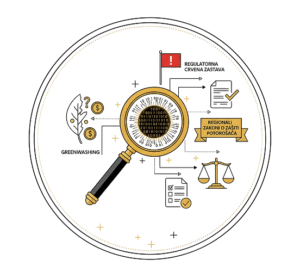
  • Greenwashing in Consumer Protection Law: Three Key Risks for Companies in the Region

    Greenwashing in Consumer Protection Law: Three Key Risks for Companies in the Region

    When “Green” Becomes a Regulatory Red Flag

    The pressure from consumers and investors for companies to act sustainably has never been greater. As a result, environmental claims have flooded the market—from “eco-friendly packaging” to “carbon-neutral” services. However, when these claims are not substantiated, we enter the zone of Greenwashing—and that’s where the Law steps in.
    In countries across the region, the Consumer Protection Act (CPA) is the main legal instrument used to sanction such practices, treating them as misleading business conduct. Greenwashing, therefore, is not just an ethical failure—it’s a direct violation of the law.

    What are the three most significant risks companies in the region face under the scrutiny of the CPA?

    The Consumer Protection Act in the region (Serbia, Croatia, Bosnia and Herzegovina, Montenegro, etc.) clearly prohibits unfair business practices, particularly those that are misleading.
    A business practice is considered misleading when a trader induces a consumer to make a purchasing decision they otherwise wouldn’t have made—by providing false or unverifiable information. This is the very definition of Greenwashing.
    A company doesn’t have to lie; it’s enough to withhold essential information or use vague, generic terms without precise scientific backing.

    Three Key Risks for Companies in the Region

    • Direct Financial Penalties
      This is the most obvious and immediate risk. The Market Inspectorate, as the main authority for enforcing the CPA, is authorized to initiate misdemeanor proceedings against companies engaged in misleading advertising.
      Penalty Amounts: The laws impose significant fines, often ranging from several thousand to tens of thousands of euros (depending on the specific country’s legislation and company size). In some cases, penalties are calculated as a percentage of annual turnover (as in the EU), making them especially painful for large corporations.
      Procedure: Sanctions are imposed once it’s determined that a claim (e.g., “100% natural” or “climate neutral”) isn’t backed by evidence (such as tests, certificates, or LCA analyses).
      Example: A company claims its product is “fully recyclable,” but ignores the fact that local recycling infrastructure cannot process that type of packaging—this constitutes a misleading claim punishable under the CPA.
    • Reputational Collapse and Loss of Consumer Trust
      Although not directly regulated by the CPA, reputational risk often has far-reaching and costlier consequences than the financial penalty itself. In the age of social media, news about a Greenwashing fine spreads rapidly.
      “Cancel Culture”: Consumers—especially younger generations—are extremely sensitive to unethical business behavior. Public backlash and boycott campaigns can cost a company millions through reduced sales and long-term brand damage.
      Impact on B2B and Investors: A reputation problem with consumers quickly extends to business partners (B2B) and investors. Loss of trust can make it harder to raise capital and may decrease share value.
    • Regulatory Measures and Mandatory Correction
      In addition to fines, a company is legally required under the Consumer Protection Act to immediately remove the misleading advertisement and, in some cases, publish a correction at its own expense.
      Correction Costs: This includes expenses for withdrawing disputed marketing materials, redesigning packaging, and—in extreme cases—recalling products from the market. This creates significant operational pressure and additional financial burdens.
      Increased Oversight: Once fined, a company becomes the target of increased scrutiny by inspection authorities. Every new environmental claim will be carefully analyzed and verified, slowing down the launch of new products and marketing campaigns.

    How to Avoid the Greenwashing Trap

    The only way to avoid these risks is by adopting the principle of provable transparency.
    Instead of relying on expensive legal battles after inspections, the focus should be on preventive measures:

    Scientific Substantiation: Every claim must be supported by internal or external technical documentation (e.g., Life-Cycle Assessment or independent certification).
    Precision: Forget vague terms like “eco-friendly.” Use precise language: “The packaging contains 30% recycled plastic” or “We reduced CO2 emissions by 15% over the past two years in production process X.”

    Legal Design Thinking (LDT): Use the LDT methodology to transform complex technical evidence into visually clear and legally defensible marketing materials—understandable to both consumers and regulators.

    Transparency as the Only Defense
    Under regional Consumer Protection Laws, Greenwashing is treated as a serious form of deception. The risks of high fines, catastrophic reputational damage, and operational paralysis are real.
    For companies in the region, the path to compliance lies in full transparency and the creation of marketing claims that are irrefutable. Otherwise, the cost of deception will always outweigh the cost of truth.

    Other blogs

    CSRD: Kada ESG postaje lični rizik. Kako Dokazna arhitektura pomjera ESG iz održivosti u odgovornost

    CSRD: When ESG Becomes a Personal Risk. How Proof Architecture Shifts ESG from Sustainability to Accountability

    March was traditionally reserved for closing the financial books. But from 2026...

    Ko će potpisati? CSRD i kraj kolektivne odgovornosti u regionalnim kompanijama

    Ko će potpisati? CSRD i kraj kolektivne odgovornosti u regionalnim kompanijama

    March in the Balkans is traditionally a month of final accounts. But in 2026, March brings…

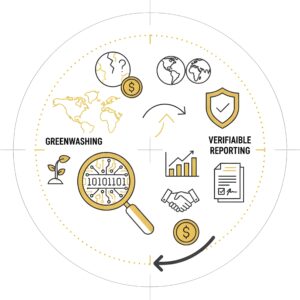
  • From “Greenwashing” to Verifiable Compliance - How to Visualize ESG Reporting?

    From “Greenwashing” to Verifiable Compliance - How to Visualize ESG Reporting?

    ESG (Environmental, Social, and Governance) reporting is no longer just a nice addition — it is a global legal obligation and one of the biggest sources of regulatory and investor risk. Companies are under increasing pressure to prove their ethical claims.

    The problem is that these reports are often a pile of scattered, textual data that are unclear for auditing and prone to suspicion of so-called “Greenwashing” (false representation of environmental or social responsibility). This is where LDT and Legal Tech come together to turn vague claims into transparent and legally verifiable evidence.

    The Risk of Unreadability: Why Do Text-Based ESG Reports Lead to Greenwashing?

    Companies use Legal Tech (RegTech platforms) to collect complex data on energy consumption, gender equality, or supply chain ethics. But when this data reaches the legal or communications team, it often turns into a long, narrative-style report.

    This creates three key problems and risks:

    • Regulatory Risk: If the reports are ambiguous, regulatory bodies (especially in the EU/Geneva) have grounds for sanctions due to false information, and the penalties are severe.
    • Loss of Investors: Investors (especially in New York) demand verifiable data. If a company cannot clearly show its progress, it loses both capital and trust.
    • Operational Chaos: Internal teams cannot easily track their contribution to ESG goals if data is scattered.

    LDT serves as a tool for turning raw data into a functional compliance system.

    LDT designs visual tools that turn complex international obligations into simple and functional business decisions.

    LDT designs an interface that not only reports compliance but also makes it simple to audit and implement internally.

    • Visual ESG Dashboard: Instead of hundreds of pages, LDT creates visual control panels. Using color codes and metrics, a single dashboard instantly shows investors where the company is green (compliant) and where it’s red (at risk).
    • Accountability Chain Map (Governance): LDT designs clear flow diagrams that visually display who within the company is responsible for each part of the ESG report. This eliminates confusion and prevents blame-shifting in case of non-compliance.
    • Report Standardization: LDT is used to create visually consistent and comparable reports for all stakeholders (regulators, consumers, investors), ensuring that the truth about compliance is told clearly and unambiguously.

    LDT and RegTech together transform ESG reporting from a regulatory burden into a strategic advantage. By designing verifiable transparency, companies not only avoid the risk of Greenwashing but also actively attract ethically driven investors.

    Is your company truly working on compliance — or has it just mastered the art of beautifully hiding uncomfortable data?

    Other blogs

    CSRD: Kada ESG postaje lični rizik. Kako Dokazna arhitektura pomjera ESG iz održivosti u odgovornost

    CSRD: When ESG Becomes a Personal Risk. How Proof Architecture Shifts ESG from Sustainability to Accountability

    March was traditionally reserved for closing the financial books. But from 2026...

    Ko će potpisati? CSRD i kraj kolektivne odgovornosti u regionalnim kompanijama

    Ko će potpisati? CSRD i kraj kolektivne odgovornosti u regionalnim kompanijama

    March in the Balkans is traditionally a month of final accounts. But in 2026, March brings…

  • Global Compliance: How to Design Rules for Data Flow Across Different Jurisdictions (EU/US)?

    Global Compliance: How to Design Rules for Data Flow Across Different Jurisdictions (EU/US)?

    Today’s business is global, and data knows no borders. Yet, laws are still local. Because of this, IT managers and lawyers face a regulatory nightmare: transferring data between jurisdictions with different legal frameworks (such as EU-GDPR and various US laws) turns into a high-risk minefield.

    Companies try to manage this risk through hundreds of pages of legal documents. However, these documents are useless in moments of quick decision. Legal Design Thinking (LDT), in combination with RegTech tools, is essential to turn that risk into an operational roadmap.

    Data is global, law is local: The regulatory complexity minefield

    The problem in global compliance lies in three key points which LDT solves:

    • Risk of fines: Violating rules on data transfer, even accidentally, leads to massive penalties (e.g., GDPR). Human error is crucial here.
    • Operational friction: Legal teams clash with operational teams about whether data can be moved from Berlin to New York. Decisions are slow, and business suffers.
    • Inefficiency of text: Traditional legal documents are too long to provide the quick, clear YES or NO decision needed in the digital economy.

    RegTech tools track legal changes in real time, but LDT is the one that designs the user interface for that information. LDT is the one that designs the user interface for that information.

    Visual management of global legal and business risks

    LDT designs visual tools that turn complex international obligations into simple and functional business decisions.

    • Visual Data Flow Map: LDT creates graphic diagrams that represent Data Pathway across different countries. The map clearly shows: What type of data can go from the EU to the US? and Which legal mechanism (e.g., Standard Contractual Clauses – SCC) must be applied? This simplifies rules into color and shape.
    • Interactive Checklists: For employees making quick decisions, LDT designs simple, visually guided tools. If an employee selects ‘Personal Data’ and ‘US,’ the tool visually shows a red light and points to the required legal clause, preventing risk in seconds.
    • Simplified Transfer Agreements: Even complex agreements like SCCs can be redesigned. LDT creates visually structured contracts that highlight the key obligations of both parties, ensuring legal teams in different jurisdictions quickly and clearly understand the agreed level of protection.

    For companies operating globally, LDT transforms compliance from an expensive obligation into an operational advantage. By creating transparent, visual rules, LDT ensures data travels safely and efficiently, without the risk of global regulatory fines. This increases business speed and builds trust.

    Given the complexity of international relations, is visual data management the only way to avoid regulatory penalties?

    Other blogs

    CSRD: Kada ESG postaje lični rizik. Kako Dokazna arhitektura pomjera ESG iz održivosti u odgovornost

    CSRD: When ESG Becomes a Personal Risk. How Proof Architecture Shifts ESG from Sustainability to Accountability

    March was traditionally reserved for closing the financial books. But from 2026...

    Ko će potpisati? CSRD i kraj kolektivne odgovornosti u regionalnim kompanijama

    Ko će potpisati? CSRD i kraj kolektivne odgovornosti u regionalnim kompanijama

    March in the Balkans is traditionally a month of final accounts. But in 2026, March brings…

  • Readiness for Attack – How to Design a Response Strategy for a Data Breach?

    Readiness for Attack – How to Design a Response Strategy for a Data Breach?

    In today’s digital reality, the question is not whether an attack will happen, but WHEN. Almost every company has a Data Breach Response Plan, but these plans are often lifeless, bureaucratic 50-page PDFs that are completely useless in moments of crisis and panic.

    In the first hours of a digital attack, it is crucial to know WHO, WHAT and WHEN must act. Legal design turns this confusing crisis into a calm and visually guided process.

    The Risk of Panic and Bureaucratic Errors

    In times of crisis, traditional plans fail because no one can quickly find the key legal clause or protocol. Panic leads to bureaucratic mistakes that are costly.

    This creates three key risks:

    1. Loss of time: Every minute is critical. Searching for answers in long documents increases response time.

    2. Increased fines: Delays in notifying regulators (e.g., under GDPR) result in huge penalties, and ignorance is no excuse.

    3. Damage to reputation: A chaotic internal reaction leads to poor external communication, causing irreparable harm to client trust.

    Legal Tech (monitoring tools) can provide automatic alerts about an attack, but Legal Design Thinking is what tells the team how to react.

    Designing a Crisis Command Center

    LDT transforms a static legal document into an operational command center

    • Visual Workflow
      LDT creates simple graphic flowcharts that can be printed and posted on the wall. The diagram clearly shows: IF a phishing attack occurs, THEN Team A is called, THEN the Legal Department is notified, and ONLY THEN does PR issue a statement. No reading – just step-by-step following.
    • Crisis Dashboard Visualization
      Using Legal Tech for notifications, LDT designs an interface that doesn’t send long emails, but instead provides a clear visual alert that immediately highlights the three priorities for that hour:
      Isolate the system,
      Do not communicate publicly,
      Contact the director.

    Simple Notification Templates: Legal obligations for notifying clients and regulators are complex. LDT designs visually guided notification templates that ensure all legal and regulatory requirements are met quickly and without error.

    LDT does not reduce the risk of a digital attack, but it drastically reduces the risk of human and bureaucratic mistakes WHEN the attack comes. It turns a stressful legal risk into an operational advantage and clearly shows that the company was prepared.

    Is it time for your Response Plan to become a visual handbook, instead of an unread legal document?

    Other blogs

    CSRD: Kada ESG postaje lični rizik. Kako Dokazna arhitektura pomjera ESG iz održivosti u odgovornost

    CSRD: When ESG Becomes a Personal Risk. How Proof Architecture Shifts ESG from Sustainability to Accountability

    March was traditionally reserved for closing the financial books. But from 2026...

    Ko će potpisati? CSRD i kraj kolektivne odgovornosti u regionalnim kompanijama

    Ko će potpisati? CSRD i kraj kolektivne odgovornosti u regionalnim kompanijama

    March in the Balkans is traditionally a month of final accounts. But in 2026, March brings…

ENG