Category: Legal Design Thinking

  • Legal chaos in the metaverse: How Legal Design Thinking brings order to the virtual world?

    The metaverse promises us a new reality – a space where we can work, create, socialize, and trade without physical boundaries. Sounds great, doesn’t it? However, where there are no boundaries, there are no traditional laws. Behind the promise of virtual freedom lies true legal chaos.

    How can we establish order in a world that does not obey the rules of physical reality?

    The rules of the old world don’t apply in the new

    Our legal systems have been built for centuries on the concepts of the tangible world: territory, ownership of physical objects, face-to-face interactions. The metaverse erases all these boundaries and creates unique problems.

    • Ownership problem: What does it really mean to own virtual property, such as a digital plot of land? If you buy something in the metaverse, do you have any rights if the platform suddenly disappears? Traditional contracts are too complex and inapplicable to property that does not exist physically.
    • Intellectual property problem: How can you protect your brand or copyrighted work when someone can make a perfect copy of your avatar or design in seconds? Traditional copyright enforcement is slow and inefficient for such an environment.
    • Jurisdiction problem: Imagine a fraud occurring in a virtual world, with the scammer in one country, the victim in another, and the server on a third continent. Whose laws apply? This creates a “legal black hole” where justice is unclear and user safety is at risk.

    Legal Design Thinking: A new compass for the legal labyrinth of the metaverse

    Instead of trying to force the digital world into outdated legal frameworks, Legal Design Thinking (LDT) offers a radically different approach. LDT is a method that combines law, design, and technology with the goal of making legal processes understandable, intuitive, and efficient. LDT does not create new laws but “redesigns” them for the new reality.

    Here’s how LDT can bring order to the metaverse:

    1. Visual contracts for digital property: Contracts for buying virtual property can be designed as interactive, visual maps. Users could see property boundaries, access rights, and terms of use without reading hundreds of pages of legal text. This makes justice more accessible.

    2. Clear licenses for digital creations: Copyright licenses can be presented as simple cards. Inside the virtual asset itself (e.g., an NFT), there could be a visual display of who the author is, what usage rights exist, and whether it can be sold. This solves the issue of transparency and fraud.

    3. Gamification of legal processes: Rules of conduct and laws can be embedded directly into the structure of the virtual world. A user who breaks the rules could receive a visual warning within the game, along with a clear explanation of the consequences. This makes justice part of the user experience rather than an external burden.

    Legal chaos in the metaverse is inevitable, but it doesn’t have to be permanent. LDT transforms abstract legal concepts into tools that empower users and enable a safer and fairer virtual experience.

    In the end, the question remains: Can justice in the virtual world, thanks to innovations like LDT, become more transparent and accessible than the one in the real world?
    Other blogs

  • LDT in the fight against cybercrime: How to catch hackers and fraudsters “in the act” legally?

    LDT in the fight against cybercrime: How to catch hackers and fraudsters “in the act” legally?

    Every day we hear about digital attacks, scams, and data theft. While cybercriminals are fast, global, and technologically advanced, the justice system often appears slow, outdated, and struggles to deal with the complexity of digital evidence.

    Behind every online offense lies a complex web of data, logs, and transactions that traditional lawyers often find incomprehensible. This is our greatest challenge: how do we turn complex digital trails into evidence a court can understand? The answer lies in Legal Design Thinking.

    When digital evidence gets lost in translation

    Imagine a fraud victim trying to file a report. On one hand, she has dozens of suspicious emails, social media messages, and bank transaction records. On the other hand, she faces an official reporting form that demands information in a format that doesn’t reflect the nature of a digital attack.

    This leads to three key problems:

    • Lack of clarity: The huge amount of digital traces confuses and complicates investigations.
    • Complexity: Lawyers and police are not IT experts. To them, digital evidence is a “black box.”
    • Obsolescence: Traditional legal forms and procedures were never designed for the speed and nature of cybercrime.

    In such a system, justice is often out of reach.

    Legal Design Thinking: A new tool in the fight against fraud

    Instead of the legal system continuing to struggle with outdated tools, LDT offers solutions that make justice accessible and transparent.

    1. Visual timelines of cyberattacks: Instead of forcing judges to go through hundreds of pages of emails, LDT allows for a visual representation of the attack. We can create a clear infographic showing the sequence of events – from the first contact with the fraudster, through money transfers, to the final theft. In this way, a complex story becomes understandable to everyone.

    2. User-oriented forms: As we outlined earlier, fraud reporting forms can be designed with victims in mind. Step-by-step instructions, clear language, and a simple format allow victims to provide all key information without stress or confusion.

    3. Clear visualization of rights: LDT can create charts and diagrams that explain which rights victims have and what the next step in the process is. This empowers victims and restores their sense of control.

    In the end, LDT is not here to replace the human factor. The goal is not for machines to deliver judgments, but to make the justice system – from reporting to trial – simpler, more efficient, and fairer.

    So, what do you think: is technology the most powerful weapon in the fight against crime, or is it still the greatest threat?

    Other blogs

  • More than an algorithm: How LDT is changing intellectual property law in digital art

    More than an algorithm: How LDT is changing intellectual property law in digital art

    Redesigning intellectual property for the 21st century: AI is a tool with skills, and humans give it vision

    Artificial intelligence (AI) is becoming an increasingly common creative partner in the world of art, design, and writing. However, this new era has created a deep divide in intellectual property law. Many believe that AI is the new author, not just a tool. But is that really the case?

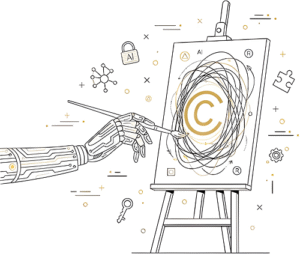
    We argue the opposite: AI is only a digital brush. Before court rulings in this field, we state our position

    AI is a tool with skills, and humans give it vision, heart, and soul

    My personal process of creating illustrations for this blog is the best proof of this claim. At first, AI didn’t understand my vision for the illustration. The results were generic and impersonal. I had to retrain the algorithm and give precise instructions until I finally achieved what I truly wanted. Every point, every line, and every detail in the final illustrations are the result of my instructions, my revisions, and ultimately a reflection of my childhood and my ideas.

    The algorithm has no memories, emotions, or vision. It doesn’t know why a certain color matters to you, nor does it understand the symbolism you bring into the final work. It only processes information. It is not the author, and we must not allow it to be presented as such.

    Legal Design Thinking: A new standard for intellectual property

    This is where Legal Design Thinking (LDT) comes in. Instead of struggling with outdated definitions and trying to force new technologies into old legal frameworks, we design solutions aligned with modern reality. We create:

    • Visual contracts that clearly define ownership of AI-generated content. This means that through a simple infographic, you immediately know what rights you have and which ones the platform retains.
    • Simple licenses that ensure artists and creators retain copyright over their works, even when using AI tools. This empowers the creator and protects their vision.
    • Transparent processes that visually show the human role in creating a work. This serves as clear and undeniable proof of authorship if a dispute ever arises.

    Intellectual property law must no longer be an obstacle. It must become an enabler for creatives in the digital era.

    Other blogs

  • More than “I agree”: How Legal Design Thinking changes terms of use and privacy policy?

    Redesign of contracts for the 21st century: Contracts everyone understands

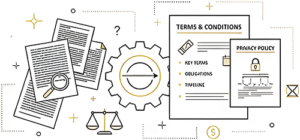
    Do you remember the last time you read the entire Terms of Use or Privacy Policy of an application? Probably not. These documents are often long, complex, and filled with legal jargon, creating a barrier between you and the service you use. Although they are essential for protecting your rights, they have become little more than “dead letters.”

    But what if these documents were clear, transparent, and easy to understand? That is exactly the goal of Legal Design Thinking (LDT) when it comes to digital agreements. We not only write these documents, but also design them with you in mind.

    Redesign of digital agreements: From complicated to understandable

    Instead of creating confusion, your Uslovi korišćenja, Politika privatnosti and cookie rules can become tools for building trust. We do this in the following ways:

    1. Visual transformation: We use visual elements such as infographics, icons, and simple tables to clearly present key information. For example, instead of a long list of texts about data collection, you can have icons that show what we collect (e-mail, location, browsing habits) and why we do it.

    2. Clear language: We replace legal jargon with simple, everyday language. Instead of “data will be used for anonymized statistical analyses”, we use “your data helps us improve our service”. This does not change legal validity, but it drastically improves comprehensibility.

    3. Interactive elements: Instead of static PDF documents, we create interactive online versions. By clicking on a certain section (e.g. “Kolačići”), a short, clear summary opens. Users can easily find the information they are interested in without searching through hundreds of pages.

    Practical example from practice

    Imagine you are developing a popular mobile application.

    Traditional approach: Your user has to go through dozens of pages of text full of legal language in order to agree to the terms. Many will simply click “Slažem se” without reading.

    LDT approach: Upon first login, the user is presented with three clear screens. Each screen has a title (“Your data”, “What you can expect?”, “How we use cookies?”), accompanied by an icon and a short, simple explanation. Only then does the user have the option “I agree”. In this way, the user is informed, and you meet legal obligations in a transparent manner.

    Wisdom of design: Ethics as the key to success

    Ultimately, LDT is not just about user experience or marketing. It is a reflection of an ethical approach to law. Instead of lawyers relying on confusing documents to “cover themselves”, we offer solutions that align with trust.

    When the Uslovi korišćenja are clear, you not only protect your business, but also show respect for the user. In today’s world, where transparency is demanded, this is the strongest asset you can have.

    Our goal is to create transparency and trust. When your users understand what they are accepting, they feel safer and are more likely to use your service. Ultimately, LDT turns boring legal documents into powerful tools for marketing and loyalty.

    Other blogs

  • How Legal Design Thinking changes your relationship with justice

    Fundamentals of the LDT approach and how to apply it in legal practice

    Law at your fingertips: how Legal Design Thinking changes your relationship with justice

    Imagine you are an entrepreneur with a vision, yet the contract placed before you feels like an impenetrable wall. Or, that you are a citizen trying to exercise your rights in a complex administrative procedure, with your only guidance being a stack of unreadable forms.

    In traditional legal practice, this is reality. But there is another way.

    That way is Legal Design Thinking — a methodology that transforms law from a complicated labyrinth into a clear navigational map. We are not simply modernizing law; we are redesigning it with one goal: to make justice accessible, transparent, and truly work for you.

    What is Legal Design Thinking and why do you need it?

    Legal Design Thinking applies design principles (empathy, visualization, simplicity) to law. Our role is not just to interpret legislation but to empower you. We achieve this through:

    Empathy as a foundation: Everything begins with deep understanding. We listen to your needs, fears, and goals, whether you are an entrepreneur starting a business, a defendant in a criminal case, or an individual in a family dispute.

    Law you can understand: We eliminate legal jargon. We turn complex legal concepts into clear, actionable advice and documents you can genuinely understand.

    Visualization as a tool: Visual tools are our strength. We create “roadmaps” that illustrate legal or administrative procedures, “IP portfolio maps” to organize your intellectual property, and “legal dashboards” to monitor compliance. Legal strategy becomes something you can see and interact with.

    Partnership, not service: You are not merely a client; you are a partner in the process. Through collaboration and feedback, we design legal solutions tailored to you and your case.

    From theory to practice: What does designed law look like?
In our practice, LDT is not only a concept, but the basis of every case.

    Criminal law: From fear to strategy. Instead of leaving you in uncertainty, we create a “case roadmap” that visually presents every stage of the procedure, giving you a sense of control in difficult moments.

    Intellectual property: From idea to protection. Your ideas are your greatest asset. We not only protect them, but organize them through an “IP portfolio map” that shows your patents, trademarks, and copyrights at a glance, enabling strategic asset management.

    AI law: From innovation to responsibility. In the world of artificial intelligence, law must be embedded in design. Through an “AI risk map,” we identify and mitigate legal and ethical risks (such as algorithmic bias and data protection) early in development.

    Business law: From bureaucracy to growth. For your company, we design a “startup roadmap” and “visual contract models” that are adaptable and easy to use. Law becomes a tool for growth, not a barrier.

    Civil law: From dispute to resolution. Whether it is contracts, inheritance, or damages, we simplify the process. We use an “inheritance map” to visually present asset distribution and “visual contracts” with clear icons to ensure transparency. Our goal is to restore law as a mechanism for problem-solving, not a source of problems.

    Foreigners’ rights: From uncertainty to clarity. For international protection or residence permits, we design a visual plan that helps you integrate into a new society with dignity and security.

    Administrative law: The state as a partner, not an obstacle. With our “bureaucracy roadmap,” you receive a clear guide through all administrative procedures.

    Social responsibility (ESG): From ethics to strategy. We turn corporate responsibility into actionable practice. We design “visual codes of conduct” and internal policies that are easy to follow, ensuring human rights compliance and preventing “greenwashing.”

    Online consultations: Law without borders, with LDT. Our online consultations are not just video calls, but structured processes. Before the meeting, we prepare you with an interactive questionnaire. During the session, we use visual tools to explain complex matters. Afterwards, you receive a graphic summary and clear action plan, not lengthy memos.

    The final result: what do you gain with the design approach?

    With Legal Design Thinking, you gain legal certainty, clear answers, and the confidence that you are in control of your situation. You reduce stress, save time and resources, and feel respected in the legal system. You receive what you are entitled to by law — without feeling neglected or that justice is selective.

    Legal Design Thinking is not just a new trend in law. It is our commitment to restoring law to what it should be — a powerful, clear, and accessible tool for everyone.

    We invite you to experience law at your fingertips.

    Other blogs

ENG